


Why a gripper matters in commercial gym equipment, even when the machine itself is doing the heavy work
In gym equipment, the word gripper can mean different things depending on context: a handle interface, a mechanical gripper in automation, or even the user-facing contact point on a press machine. In strength equipment, that distinction matters more than people think. The part you hold, brace against, or drive through is where a lot of the day-to-day wear, comfort, and control decisions get made. On a plate-loaded press machine, for example, the grips and support points are not decorative. They help determine whether the movement feels stable, whether users can find their position quickly, and whether the machine survives repeated commercial use without becoming loose or unpleasant to use.
For sourcing managers and gym operators, this is not a minor detail. A machine can look solid on a spec sheet and still disappoint if the contact points are awkward, the pad placement is clumsy, or the moving arms feel rough under load. The buyer is not just choosing steel and paint; they are choosing how the equipment will behave in daily traffic, under different body sizes, and with a mix of experienced and novice users.
What the machine appears to be, and what can be said with confidence
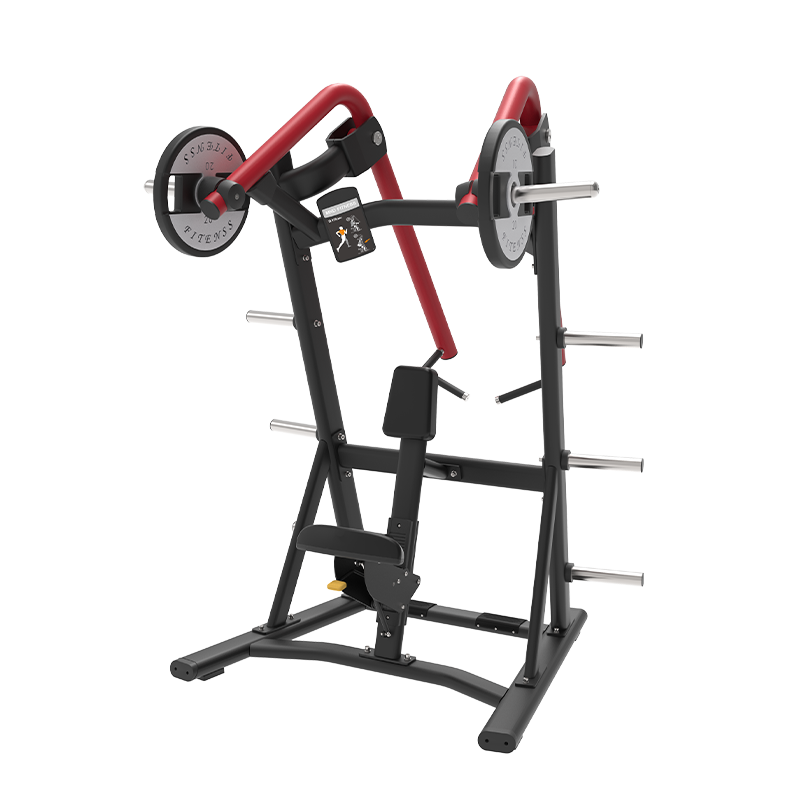
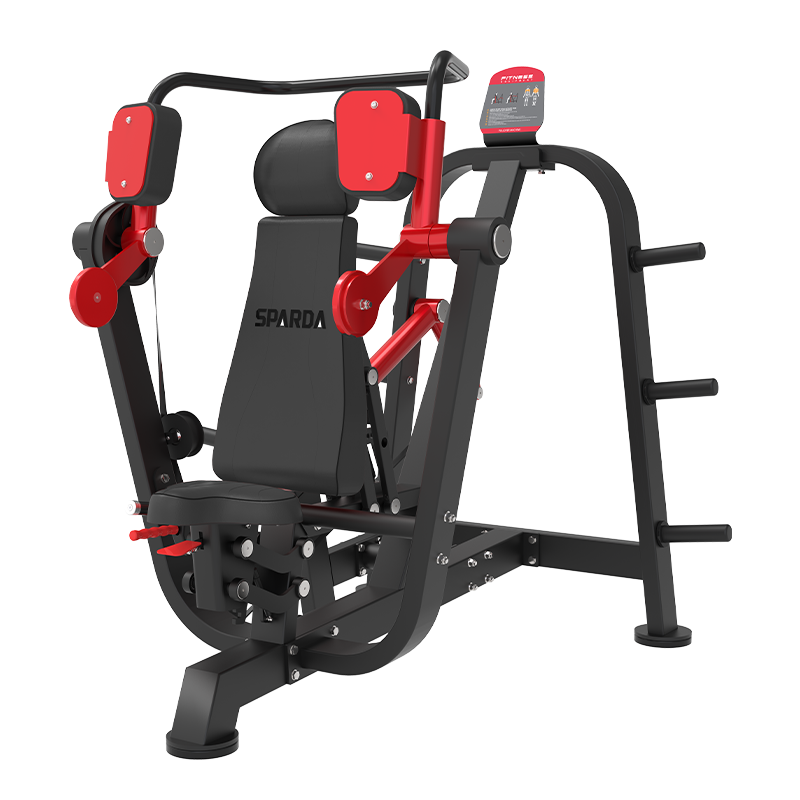
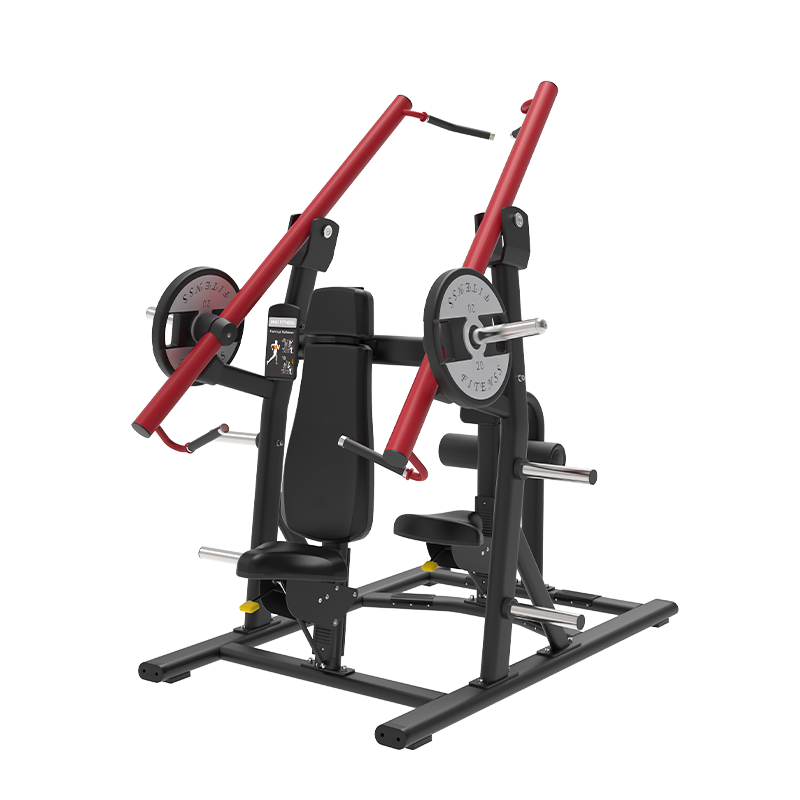
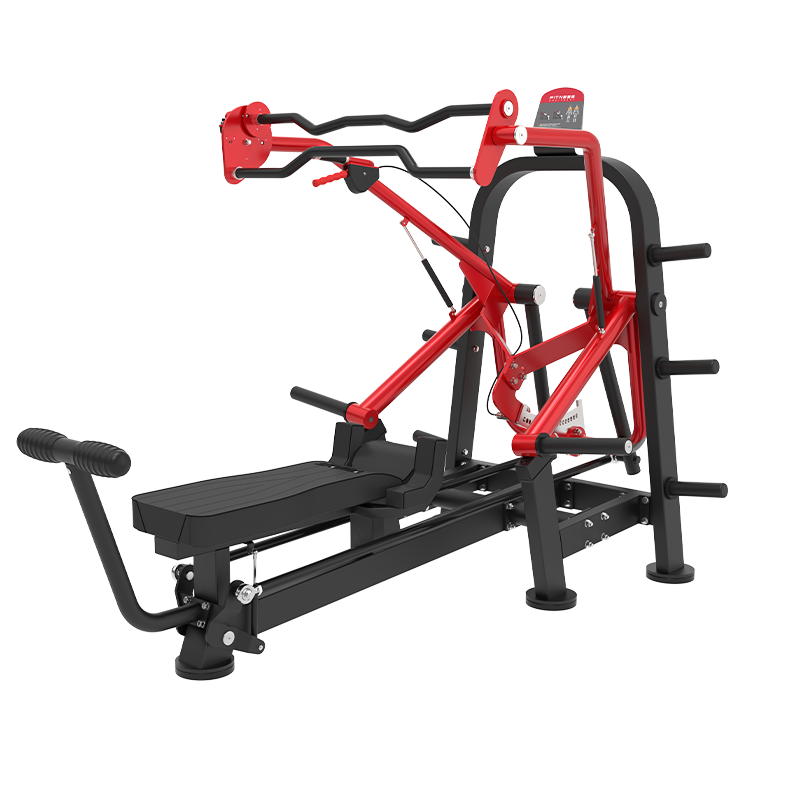
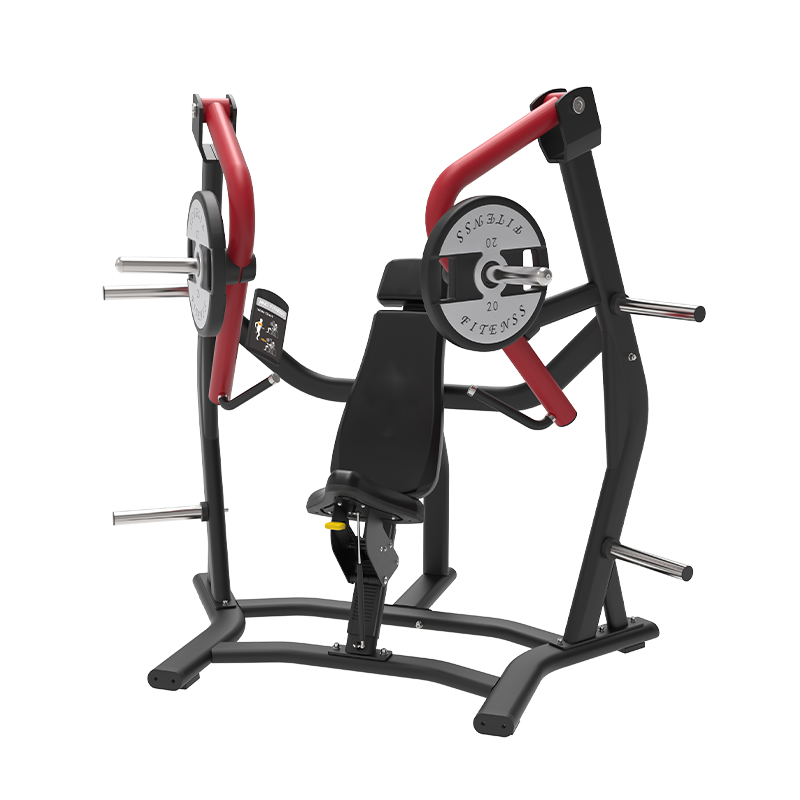
The product information points to a plate-loaded strength training machine in the shoulder press / overhead press family. The visible layout suggests a standing or seated guided press: an upright welded steel frame, lever arms pivoting near the top, dual plate-loading horns on both sides, and padded support elements for positioning the user. That combination is common in commercial facilities because it gives the feel of a press while controlling the path of motion.
A few details are clear enough to note without overreaching. The frame appears to use welded steel tubing with a black powder-coated finish. There are red-painted tubular members on some of the moving or accent parts, and black upholstered pads for support. The wide base is the sort of feature buyers should notice; a press machine must resist rocking when users drive force into the handles. The plate-loading horns are horizontal and visible on both sides, which is a practical setup for standard gym plate workflow, though the exact plate standard should not be assumed beyond visible compatibility.
The machine also appears to include multiple positioning elements: a central pad/back or chest support, plus a lower seat or pad assembly. That suggests adjustable body positioning, which is useful in shared-use environments where user heights vary widely.
Quick buyer takeaway: what to evaluate before you order
If you are comparing this kind of machine against other commercial strength equipment, focus on four things first:
1. How stable the frame looks under off-center loading.
2. Whether the handle and support geometry seems suitable for a range of users.
3. Whether the pivoting arms appear smooth and accessible for maintenance.
4. How well the pads, grips, and finish will hold up in a busy training room.
That is the practical side of the buying decision. The machine may be described as a shoulder press, overhead press, or guided press variant depending on the seller, but the real question is simpler: does it give users a controlled press pattern without feeling cramped, sticky, or underbuilt?
Manufacturing details that separate a decent machine from a frustrating one
Commercial gym equipment fabrication is a mix of structural engineering and production discipline. For a machine like this, the main processes usually include tube bending, welding, machining of pivot joints and shafts, powder coating, and upholstery assembly. Each step affects the final user experience.
Welding quality influences alignment. If the frame is even slightly out, the lever arms can sit unevenly or travel with inconsistent resistance. Machined pivot points matter because a press machine lives and dies on how the moving arms feel. Too much play and the machine feels cheap; too little and it may bind or wear prematurely. Powder coating is not just about appearance either. In a commercial environment, scuffs and sweat exposure are routine, so finish durability affects resale value and service intervals.
Upholstery deserves more attention than it usually gets. Pads on a guided press take repeated compression, friction, and cleaning chemicals. If the cover material is thin or poorly stretched, it can wrinkle, split, or look tired long before the steel frame has any real structural wear. That is where a buyer should ask practical questions, even if the supplier’s brochure is mostly focused on the mechanism.
Mechanical gripper, electric gripper, pneumatic gripper: why those terms show up in buyer conversations
The related keywords point to industrial gripper categories, and while those are not the same as gym handles, the comparison is useful. In automation, a mechanical gripper relies on linkages and physical force transfer. An electric gripper adds controlled actuation, often for more precise positioning. A pneumatic gripper uses air pressure and is common where speed and simple operation matter.
Why mention them here at all? Because equipment buyers often borrow language from other manufacturing sectors when they talk about grip, clamp, and contact control. In a gym machine, the “gripper” function is usually mechanical and passive rather than powered. But the same purchasing logic applies: the interface must be reliable, repeatable, and easy to maintain. If the grips, handles, or support points wear out quickly, the machine becomes awkward even if the main frame is still fine.
That is also why it helps to think beyond the headline feature. A commercial press machine is not only about resistance. It is about how force is transmitted through the user’s body and into the frame. The contact points are small details with outsized impact.
Selection criteria for commercial gyms and training facilities
For commercial gyms, hotel gyms, training studios, and rehabilitation-oriented fitness spaces, the selection process should start with usage profile. A busy facility needs a machine that is forgiving in setup and durable under inconsistent handling. A more specialized strength and conditioning room may care more about loading efficiency and movement feel.
Here are the checks that matter most:
1. Frame footprint and stability
A wide base is a positive sign, especially for a press machine with lever arms and plate loading on both sides. The frame should look anchored and resistant to tip or sway during hard reps.
2. User positioning
Multiple adjustment points are useful, but only if they are intuitive. A machine that offers several positions but requires trial and error will slow down floor traffic and frustrate users.
3. Grip and pad contact
This is where the gripper conversation becomes practical. Handles should support a secure, natural hold. Pads should stabilize the user without forcing an unnatural posture. In a shared facility, awkward contact geometry gets complained about faster than raw weight numbers.
4. Maintainability
If the pivot joints are hard to access, maintenance becomes a nuisance. In commercial equipment, simple service access is often worth more than a flashy design detail.
5. Finish durability
Black powder coating is common for a reason, but not all coatings behave the same. Gym traffic, cleaning routines, and incidental impacts will reveal the difference.
Where buyers often go wrong
One common mistake is judging a plate-loaded press by appearance alone. Heavy tubing and a tall frame look reassuring, but a machine can still feel awkward if the lever path is poorly shaped. Another mistake is ignoring pad placement. Users of different sizes need enough room to get set without feeling pinned into one posture.
A second buyer-facing warning: do not assume every plate-loaded machine is equally convenient just because it accepts Olympic-style plates. Plate loading can be efficient, but if the horns are too awkward to reach or the machine needs frequent re-racking adjustments, the operator experience suffers. In a crowded gym, those small frictions add up.
It is also easy to overfocus on the moving arms and forget the floor interface. A stable frame and sensible center of gravity are not luxury features. They are part of the machine’s daily safety and usability.
How Minolta fits into the commercial equipment picture
Shandong Minolta Fitness Equipment Co., Ltd. operates from Ningjin’s hardware industry base and offers a wide range of commercial gym equipment, including strength and cardio series. The company information describes a 120,000-square-meter facility with a manufacturing workshop, quality control lab, and exhibition hall. It also notes more than 300 types of exercise equipment and exports to over 100 countries across Europe, Africa, the Middle East, South America, and Southeast Asia.
For buyers, that kind of background matters less as a slogan and more as an indicator of production scope. A supplier with broad product coverage is usually better positioned to support matching equipment families, finish consistency, and commercial ordering patterns. That does not replace a proper technical review, of course, but it does help when you need a line of equipment that looks coherent across a facility.
Practical questions to ask before placing an order
If you are evaluating this type of press machine, ask the supplier for clarifications on the items that were not visible in the product data:
- Exact model name and exercise designation
- Load capacity
- Dimensions and floor space requirement
- Pad adjustability range
- Pivot and bearing construction details
- Weight of the machine
- Plate compatibility details beyond visible horns
Those are not trivial questions. They are the questions that determine whether the machine fits the room, the users, and the maintenance plan.
FAQ for buyers
Is this machine suitable for commercial use?
Based on the visible structure and the company’s commercial equipment profile, it appears intended for commercial environments such as gyms and training centers. Final suitability still depends on the exact build specification.
Does the machine rely on plates or a selectorized stack?
The visible plate-loading horns indicate a plate-loaded design.
Can it be used in rehabilitation settings?
Potentially, yes, but that depends on the facility’s programming, supervision, and the machine’s actual adjustment range. It should not be assumed without confirmation.
What should I inspect first on delivery?
Check welds, alignment of the moving arms, pad mounting, coating quality, and whether the grips and loading horns are cleanly finished.
What a good next step looks like
If you are shortlisting a gripper-style guided press machine for a commercial facility, start with the mechanics, not the marketing copy. Review the frame layout, the contact points, and the service access. Then ask for the missing technical data before you commit to a purchase. A well-built machine should be easy to understand the moment you stand in front of it: the handles should make sense, the pads should support the user without awkwardness, and the frame should look like it could survive a busy room.
For procurement teams comparing multiple strength machines, that is often the most useful test of all. The best equipment is rarely the loudest on the catalog page. It is the one that disappears into daily use and keeps doing its job long after the novelty wears off.