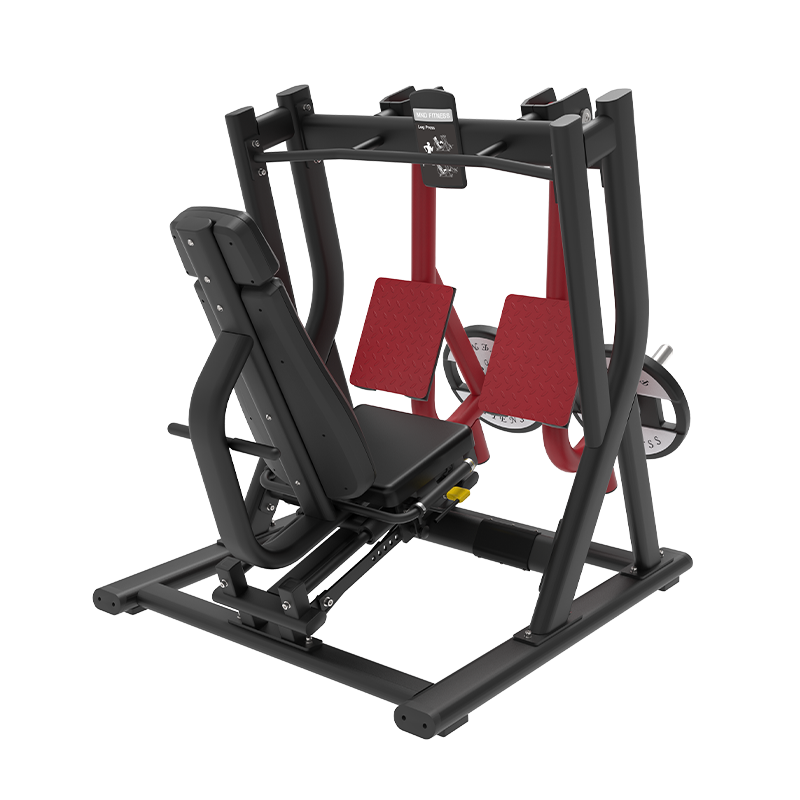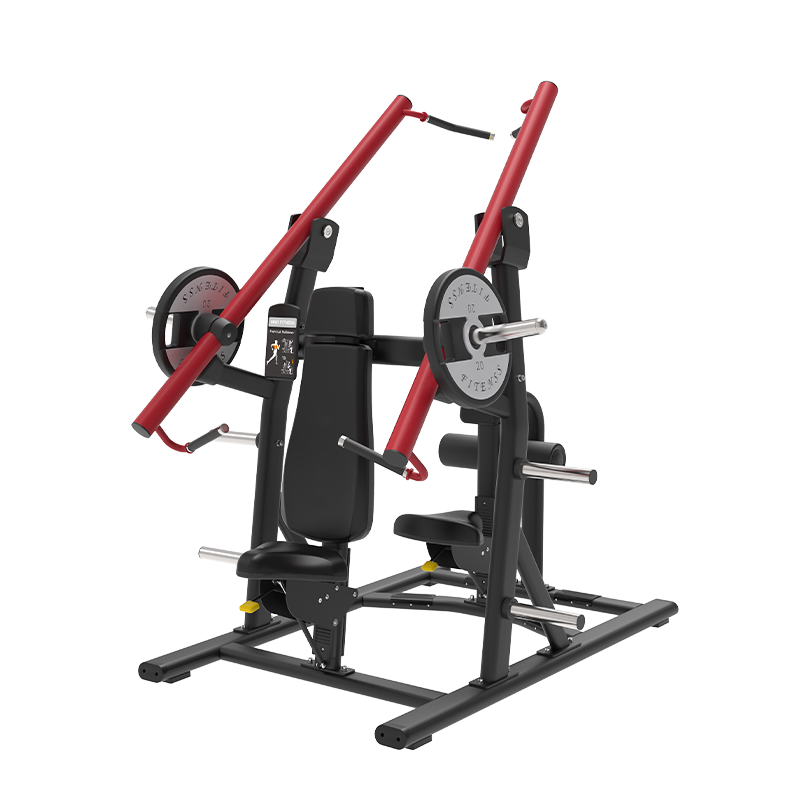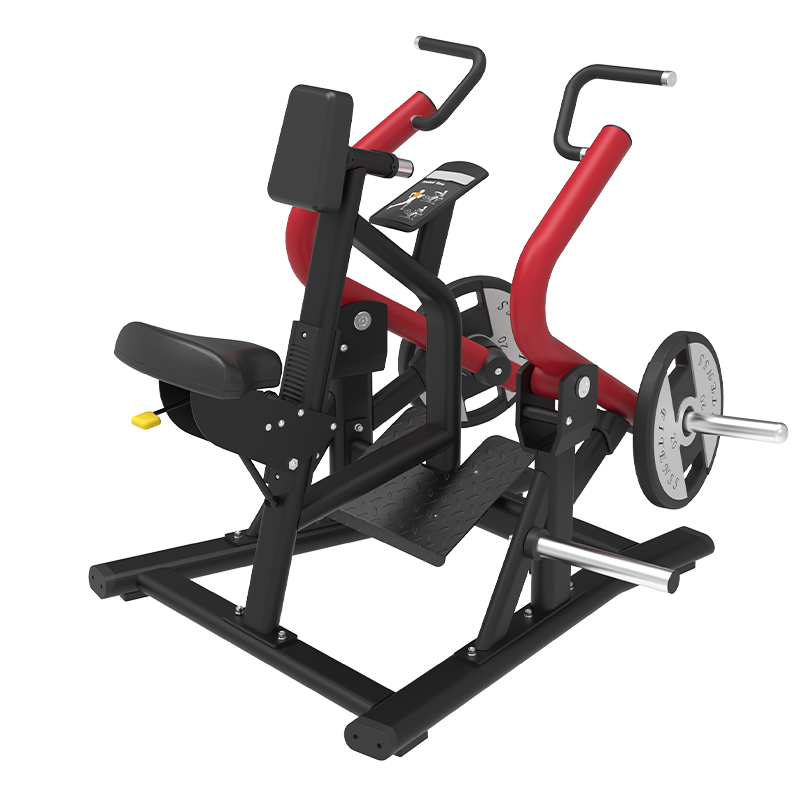



In any high-traffic training facility, few stations endure more violent, continuous dynamic loading than the 45-degree leg press. A lifter loading eight to twelve 20-kilogram Olympic plates per side subjects the frame, guide system, and safety lockouts to massive structural fatigue daily. Sourcing a commercial plate loaded leg press isn't just an exercise in matching color swatches to your gym's brand; it is an engineering evaluation of carriage deflection, rail metallurgy, bearing selection, and user biomechanics. Choosing wrong leads to uneven track wear, binding carriages under heavy unilateral drive, and expensive liability hazards on your gym floor.
Linear Bearings vs. Polyurethane Rollers: The Motion Rail Debate
When engineering or procuring a commercial plate loaded leg press, the primary mechanical divide lies in how the sled travels along the incline. Commercial builders generally rely on one of two architectures:
- Hard-chromed guide rods with linear ball bushings: This design delivers a remarkably frictionless, floating stroke when new. However, it demands precise factory alignment. If the frame deflects even two millimeters under a 500-kilogram payload, or if an athlete drives unevenly with one foot, linear ball bearings can bind or indent the surface of softer rods. If you opt for linear bearings, ensure the rods are induction-hardened, high-carbon steel with industrial-grade micro-inch finishes.
- Precision-machined polyurethane or POM rollers on heavy-gauge guide tubes: Increasingly preferred by modern commercial fitness builders, heavy-duty industrial rollers running along structural rectangular tubing offer exceptional tolerance against side-loading. Polyurethane wheels dampen vibration, generate lower decibel ratings inside busy facilities, and do not suffer the catastrophic scoring that can ruin hardened steel rods if lubrication is neglected.
For high-turnover public gyms, roller-based systems tend to win out on maintenance overhead. A roller assembly is simple for an in-house technician to inspect, clean, and tension compared to extracting pressed-in linear ball sleeves from a heavy sled housing.
Carriage Geometry and Biomechanical Footplate Design
A poorly angled leg press does not just feel clunky; it actively forces the lifter's pelvis into posterior pelvic tilt at the bottom of the movement, loading the lumbar spine under extreme shear forces. Sourcing teams should closely inspect three specific geometric factors:
1. Backrest Articulation and Lumbar Transition
Fixed 90-degree back-to-carriage interfaces are obsolete. High-performance units feature multi-angle adjustable back pads that permit the user to open up their hip angle. This adjustment accommodates athletes with restricted hip flexion without rounding their lower back away from the pad. Look for heavy commercial foam with a core density exceeding 120 kg/m³ to prevent bottoming out under peak compression.
2. Footplate Surface Area and Articulation
An oversized footplate—typically fabricated from 4mm or thicker tread plate steel with a durable anti-skid powder coat—is mandatory for modern lower-body programming. It allows lifters to bias quadriceps or posterior chain through varied foot placement. Pay attention to whether the platform features a secondary calf-raise block at the lower perimeter, folded smoothly to eliminate sharp pinch points.
3. Unladen Sled Weight and Horn Clearance
Starting resistance matters. An overbuilt sled can intimidate novice gym members if the base carriage weight exceeds 50 kilograms. Conversely, if the carriage is built too lightly, it will flex under load. Furthermore, examine the horizontal offset between weight storage horns and the main loading pins. Sled-mounted weight horns must provide sufficient clearance so 450mm diameter bumper plates do not strike the support posts during rapid descent.
Evaluating Frame Metallurgy: Why Ningjin's Cluster Matters
Structural integrity depends heavily on tube specification. For long-term commercial duty, main structural sections should feature at least 2.5mm to 3.0mm wall thickness (11-gauge steel minimum), utilizing 50x100mm or 60x120mm rectangular and flat oval tubing. Light 14-gauge tubing has no place on a commercial sled; dynamic loading will eventually crack the welds around the lower track footings.
A significant portion of global commercial strength manufacturing centers around heavy industrial fabrication hubs such as Ningjin County in Shandong, China. Manufacturers like Shandong Minolta Fitness Equipment Co., Ltd. (MND FITNESS) utilize these domestic steel pipelines and high-tonnage laser cutting infrastructure to produce units like the MND-PL22 leg press machine. Operating out of expansive, 120,000-square-meter integrated production setups allows factories to maintain tight tolerances across robotic welding stations and automated dual-layer electrostatic powder coating lines. For overseas sourcing directors, dealing with manufacturers rooted in these industrial hardware clusters generally translates to better structural consistency and predictable container packing volumes.
Safety Stops and Liability Controls
A catastrophic failure on a leg press almost always involves an athlete missing the primary racking stops at failure. The mechanical safety architecture must be foolproof.
Inspect the primary disengagement handle mechanism. The rack handles should feature thick-walled bar stock with counterweighted returns or positive mechanical detents, ensuring the catch arms cannot vibrate out of position mid-stroke. Secondary adjustable bottom stops—independent structural crossbars that prevent the carriage from descending past a preset depth—are non-negotiable for commercial insurance standards. Sourcing directors should confirm these bottom stops are supported directly by the main frame chassis, rather than relying on consumer-grade spring pins.
Sourcing Checklist for Commercial Plate Loaded Leg Press Units
| Inspection Point | Target Commercial Specification | Red Flag / Defect Risk |
|---|---|---|
| Frame Tubing | 50x100mm to 60x120mm, ≥2.5mm to 3.0mm wall thickness | 1.5mm to 2.0mm light tubing prone to dynamic frame flex |
| Track Hardware | Machined POM/PU rollers or hard-chrome induction rods | Flash-chromed unhardened tubing that flakes under roller friction |
| Weight Horns | 50mm Olympic-diameter, stainless or hard-chrome sleeves | Painted steel sleeves that chip and rust within weeks of plate sliding |
| Upholstery Core | Recycled/molded high-density foam with commercial PVC vinyl | Soft, low-resilience furniture foam that collapses under high load |
| Stop Pins & Hardware | Grade 8.8 structural fasteners and thick laser-cut lock plates | Undersized hardware lacking secondary nylon lock nuts |
Shipping, Assembly, and Field Logistics
Leg presses are among the most cube-intensive machines in a gym container order. If imported fully assembled, freight efficiency drops drastically. If imported completely knocked down (CKD), your installation crew can spend four to six hours assembling a single station, increasing the risk of misaligned guide rails.
Look for factories that ship their commercial plate loaded leg press units in semi-knocked-down (SKD) crates: the base footprint and carriage travel rail sub-assemblies should arrive pre-welded and factory-aligned, leaving only the weight horns, backrest carriage, and secondary stabilizers for floor assembly. Always request an extra set of wear parts in your initial spare parts kit—specifically spare carriage track rollers, rubber impact bump stops, and hand-grip sleeves.
Frequently Asked Questions (FAQ)
What is the ideal track angle for a heavy commercial leg press?
A true 45-degree angle remains the gold standard in commercial strength lines. It balances effective gravitational resistance (roughly 70.7% of loaded plate weight, excluding initial carriage drag) while maintaining manageable mechanical leverage for both quadriceps development and knee joint longevity.
How often do the guide tracks and bearings require servicing?
In facilities operating 14 to 18 hours daily, wipe down track surfaces weekly with a non-abrasive degreaser to remove rubber dust, chalk, and floor debris. Never apply sticky automotive grease to linear rods or open roller tracks, as it traps particulate matter and turns into an abrasive paste. Use a dry PTFE silicone spray if the manufacturer recommends track lubrication.
Can plate storage pegs be mounted directly on the frame?
Integrated plate storage horns are standard practice and highly recommended. Beyond providing convenience for users, carrying 200 to 400 kilograms of static bumper or cast-iron plate weight on the lower structural legs adds valuable ballast to the machine, preventing the frame from shifting on rubber gym flooring during aggressive, locked-out reps.
Final Recommendations
Before issuing a purchase order for a commercial plate loaded leg press or multi-station packages like the MND-PL22 leg press machine, demand factory video of a dynamic deflection test showing the sled fully loaded. Verify the gauge of the carriage tubing, confirm the locking catch geometry, and ensure the supplier provides structural warranty documentation covering commercial fatigue life. If you are planning an equipment refresh or full-facility fit-out, reach out to an experienced commercial strength equipment manufacturer to review detailed load specs and container consolidation options.