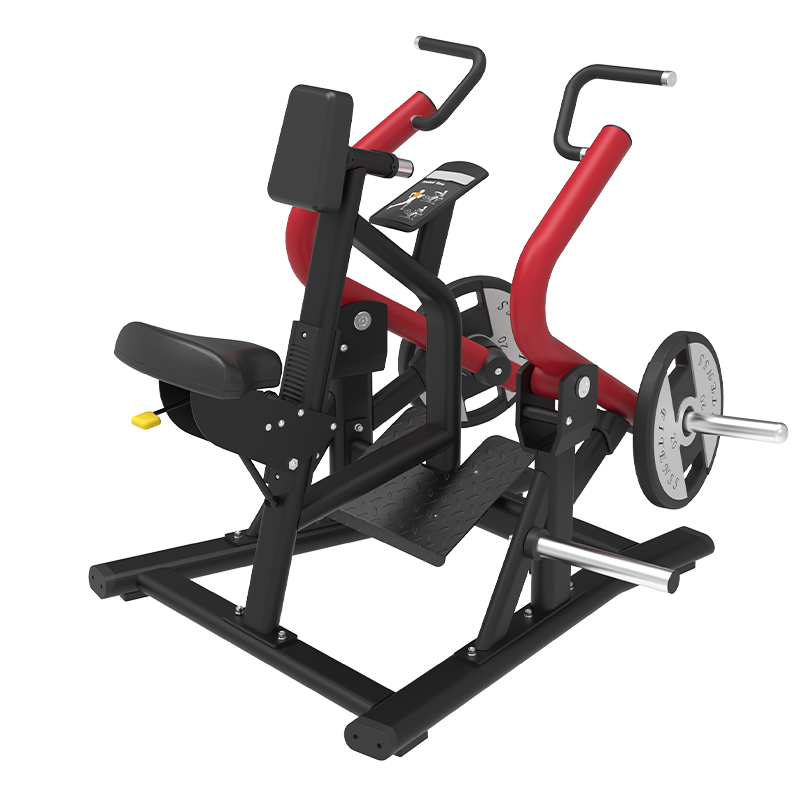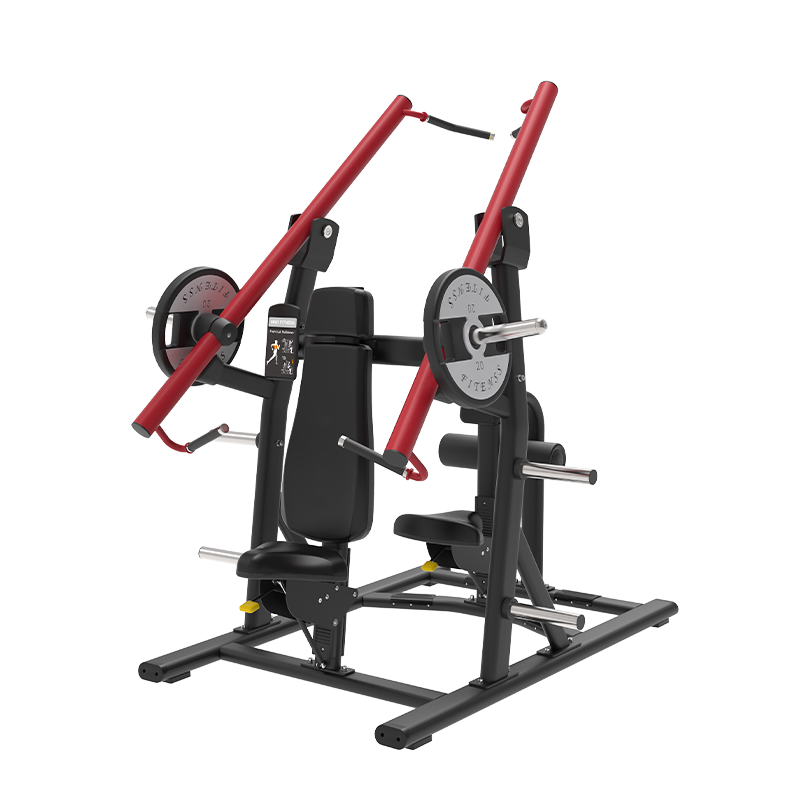



When outfitting a strength floor, few pieces see heavier, more sustained abuse than a commercial back station. Cable systems frequently suffer from frayed wire ropes and bent selector pins, while selectorized stacks can limit stronger lifters. Because of this, facility operators consistently turn to the plate loaded seated row machine to bridge the gap between barbell free-weight training and guided machine safety. For gym owners and procurement directors, choosing the right unit is less about visual styling and more about axis geometry, structural longevity, and how intuitively the machine accommodates varied lifter builds.
Whether you are outfitting an independent strength gym or sourcing containers for commercial fitness franchises, evaluating a commercial gym back machine requires looking beyond glossy catalog renders. You have to examine pivot bearings, tubing cross-sections, adjustment mechanisms, and chest-pad bracing.
Kinematics and Lever Geometry: Why Pivot Placement Dictates Results
The biomechanical path of a row dictates whether a lifter recruits the latissimus dorsi or the upper-middle back (rhomboids, rear deltoids, and mid-trapezius). On a well-engineered plate loaded seated row machine, the movement path is rarely a straight horizontal pull.
Most commercial buyers favor converging or independent iso-lateral arms over single-axle designs. Here is why lever configuration matters on the floor:
- Independent Iso-Lateral Movement: Lifters rarely pull with equal strength on both sides. Fixed dual-grip bars allow the dominant side to compensate, which accelerates wear on one side of the pivot sleeve. Iso-lateral arms force equal effort, eliminate structural torque across a single axle, and allow alternating or unilateral training protocols.
- Converging vs. Neutral Arcs: A pull arc that starts slightly wider than shoulder-width and converges slightly inward naturally tracks the human humerus during shoulder extension. It provides deeper muscular contraction at full retraction without stressing the anterior capsule of the shoulder.
- Multi-Grip Orientation: A functional row station should offer at least two handle angles: a neutral (palms facing) grip for tucked-elbow lat recruitment, and a pronated (overhand) or semi-pronated grip for mid-back retractor development. Rigid, non-rotating handles with moderate knurling or high-durometer urethane coatings hold up best under chalk and heavy sweat.
Structural Standards: Frame, Bearings, and Wear Points
In high-throughput facilities, a seated row absorbs violent eccentric loading. Lifters often release loaded arms prematurely or bounce repetitions at maximum stretch. If the structural engineering is cut short, frames flex, welds crack, and bearings bind.
When reviewing technical specifications from manufacturers, keep these minimum engineering thresholds in mind:
Steel Tubing Specification: Commercial strength frames should utilize structural steel tubing—typically 50x100 mm, 60x120 mm, or heavy-gauge square sections with a minimum wall thickness of 2.5 mm to 3.0 mm (11-gauge). Lighter 14-gauge tubing belongs in light-commercial or residential gear; under heavy Olympic plate loads, thin-walled tubing will warp over time around the pivot junctions.
Pivot Assembly: Avoid bronze or nylon bushings on primary rotation points. Industrial-grade, sealed deep-groove ball bearings or pillow-block assemblies ensure smooth rotation under 200+ kilograms of plate resistance. The pivot shaft should be ground solid alloy steel, secured with mechanical locking collars rather than simple snap rings.
Chest Pad and Seat Engineering: The chest pad serves as the fulcrum for the user's torso. If the pad is too soft, the lifter sinks in and loses spinal neutrality; if it is too narrow, it digs painfully into the sternum. Look for high-density molded polyurethane foam wrapped in commercial-grade vinyl (minimum 1.2 mm thickness) with double-stitched perimeter seams. Plywood backer boards should be high-ply hardwood, not low-density particleboard that strips out under T-nut tension.
Plate Loaded vs. Pin-Selected: Maintenance and Footprint Considerations
Before allocating square footage, commercial operators must weigh the operational trade-offs of plate loading against weight-stack towers.
From a maintenance perspective, plate-loaded rows offer massive dividends. There are no selector cables to stretch or replace, no weight stack guide rods that require monthly silicone lubrication, and no magnetic selector pins for members to steal or bend. The primary maintenance routine comes down to checking pivot bolt torque, inspecting rubber bump stops, and wiping down the upholstery.
The trade-off is plate management. A plate loaded seated row machine requires adequate clearance on either side for loading and unloading standard 450 mm Olympic bumper or iron plates. If a machine's plate horns sit too close to adjacent equipment or structural pillars, you create pinch hazards and user frustration. As a rule of thumb, budget at least 600 mm of unobstructed buffer space around each weight horn.
Evaluating Build Standards at the Factory Level
Sourcing commercial gym back machine inventory directly from manufacturing hubs requires practical due diligence. In regions like Ningjin County in Shandong, China—widely recognized as a major industrial cluster for commercial gym hardware—factories operate across distinctly different quality tiers.
Manufacturers like Shandong Minolta Fitness Equipment Co., Ltd. (MND FITNESS) utilize expansive production environments—often exceeding 100,000 square meters—to integrate automated laser cutting, robotic welding, and specialized electrostatic powder-coating lines. When evaluating series options (such as MND's heavy-duty commercial lines ranging from MND-AN, MND-FM, to heavy-plate series like MND-F and MND-FF), buyers should ask the engineering team specific questions:
- Surface Pre-Treatment: Is the frame shot-blasted or acid-pickled prior to powder coating? Without proper surface preparation, powder coat easily chips away around plate storage horns when steel Olympic plates repeatedly impact the frame.
- Plate Horn Materials: Are the weight horns finished in cheap chrome plating, or do they feature hard chrome, stainless steel, or polyurethane sleeves? Thin chrome flakes off quickly under commercial steel plates, leaving unsightly rust spots. Polyurethane or stainless sleeves provide far better service longevity.
- Seat Adjustments: Does the seat post use a friction pin, or a spring-loaded, positive-locking pop-pin with CNC-machined engagement holes? Friction locks slip under load; positive engagement stops do not.
Practical Buyer FAQ
What is the ideal chest pad angle on a seated row?
A vertical or slightly reclined chest pad (5 to 10 degrees forward tilt at the top) is preferable. This angle allows lifters to brace firmly through their feet and hips without their rib cage sliding upward during heavy eccentric phases.
Can shorter or taller lifters use fixed-path plate-loaded rows comfortably?
Only if both the seat height and the chest pad depth adjust independently. If the chest pad is fixed and only the seat moves up and down, lifters with longer or shorter arm reaches will struggle to reach full extension without losing chest contact with the pad.
How many plate storage horns should the machine feature?
Integrated storage horns are convenient, but only if they do not obstruct the lifter's loading path on the active swing arms. Well-designed machines place passive weight-plate storage horns low and to the rear of the main upright, saving floor space while keeping plates within easy reach.
Final Procurement Steps
When selecting a commercial plate-loaded row, prioritize movement feel, frame rigidity, and bearing quality above all else. Request raw weld photos, powder coating specifications, and exploded assembly schematics from your supplier before placing container orders. Testing a physical sample or inspecting a manufacturer's QC testing procedures gives you the clarity needed to install machinery that stands up to years of commercial use.