


Shoulder pain is not always a shoulder problem, and that matters for buyers
Shoulder pain is one of those complaints that shows up everywhere: in commercial gyms, school training rooms, physiotherapy-adjacent strength spaces, and home setups where people want to train hard without aggravating an old issue. For sourcing managers and facility owners, the challenge is not just finding equipment that looks sturdy. It is choosing training hardware that supports pressing, stabilizing, and rebuilding strength without turning a manageable shoulder injury into a repeat complaint.
That is why a plate-loaded chest press or incline press machine can be more useful than it first appears. When built correctly, it gives the user a controlled pressing path, seated support, and load progression that is easier to manage than a barbell on a bad day. For facilities thinking about shoulder pain treatment-adjacent training, or simply trying to give members a safer option during return-to-training phases, that combination can be more important than flashy branding.
Shandong Minolta Fitness Equipment Co., Ltd. sits in a useful position here. With more than a decade in fitness equipment manufacturing, a 120,000-square-meter facility, and a catalog that spans commercial strength and cardio lines, the company is clearly operating at a scale where welded steel frames, powder coating, pivot hardware, and upholstery assembly are familiar territory. That matters because shoulder-focused pressing equipment lives or dies on manufacturing quality. A machine that wobbles, binds, or places the handles awkwardly can irritate the very joint it is supposed to help train.
Why pressing equipment matters when shoulder pain is in the picture
People often assume that if the shoulder hurts, all pressing should stop. That is too blunt for most real training environments. The better question is what movement can be tolerated, under what load, and with what support. A good machine gives the user a predictable path and reduces the coordination burden compared with free weights. For someone dealing with frozen shoulder, a past dislocated shoulder, or lingering rotator cuff irritation, predictability is not a luxury. It is the difference between a usable session and a skipped session.
Commercial facilities need that nuance. Members do not arrive with neat diagnosis labels. One person says shoulder pain, another says shoulder injury, and a third wants shoulder exercises because their physical therapist told them to stay active. The facility cannot diagnose, but it can provide equipment that is mechanically sensible, easy to coach, and less intimidating than a barbell bench or a deep dip station.
What the machine design tells a buyer
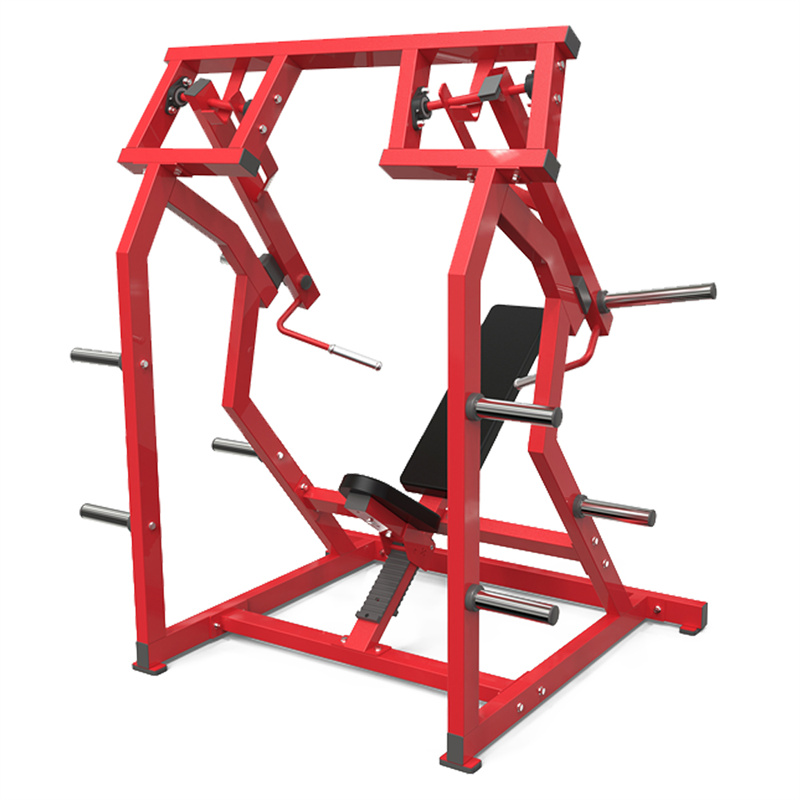
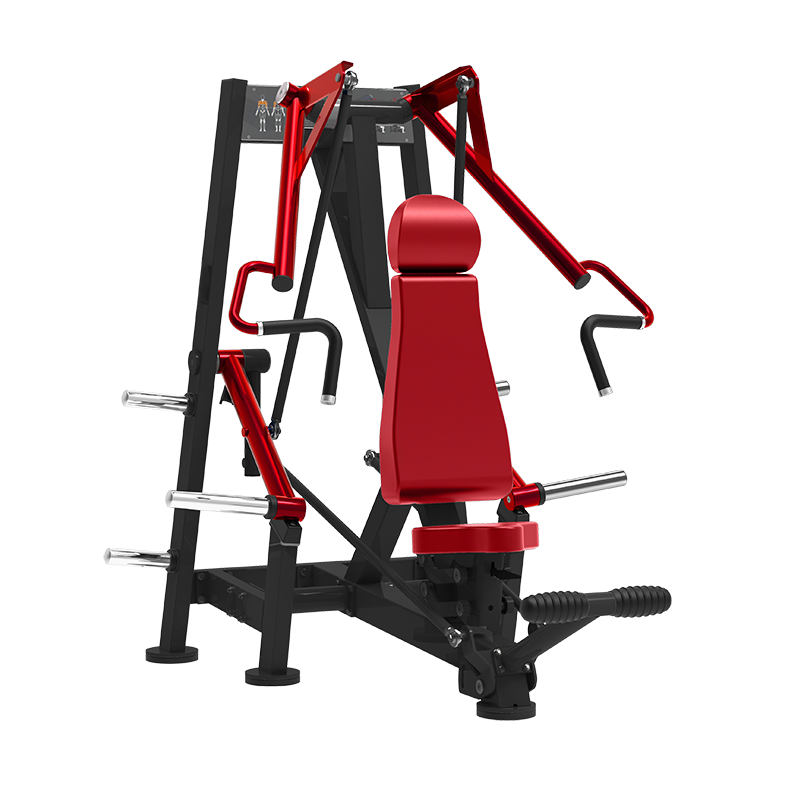
The equipment described here is a plate-loaded strength training machine, likely a chest press or incline press variant, with side-mounted loading pegs and a seated, supported pressing position. That design tells you several practical things immediately.
First, the plate-loaded format makes load progression simple. Facilities can use standard plates rather than relying on a weight stack. Second, the independent or semi-independent arm structure, while not confirmed in every detail, suggests a more natural pressing feel than a fixed single-path arm. Third, the padded seat and backrest imply a focus on body positioning, which is critical when the user is protecting a painful shoulder.
The visible heavy steel frame, red powder-coated finish, chrome or steel loading pegs, and multiple adjustment points point to commercial gym equipment fabrication rather than a light-duty home appliance. That is important for buyers because shoulder-friendly training should not come at the cost of machine stability. If the frame flexes or the pivots feel sloppy, the user experiences that as instability in the shoulder itself.
Key takeaway for sourcing teams
If the goal is to support users with shoulder pain treatment considerations, the machine should not simply be “press-like.” It should be stable, easy to enter and exit, and forgiving in its arm path. Those are manufacturing and ergonomics issues, not marketing language.
What makes a press machine more usable for sore shoulders
Not every shoulder-friendly press looks the same, but the better ones usually share a few traits. The first is a seated position with solid back support. When the torso is stabilized, the shoulder is not forced to compensate for trunk sway. The second is a controlled lever path. Free weights demand more stabilization, which can be helpful for some users and a poor fit for others. The third is room for gradual loading. That matters for rotator cuff rehabilitation phases, when big jumps in resistance are often unwise.
Another practical factor is handle placement. If the grips sit at an awkward angle, the user may flare the elbows excessively or lock into a range that feels harsh on the front of the shoulder. A decent machine gives the user a pressing angle that can be tolerated without feeling jammed at the bottom or overextended at the top. This is one reason many coaches prefer machine pressing as a bridge between rest and free-weight return.
That said, a machine is not a cure. It is a tool. If someone has a fresh injury, unexplained pain, numbness, or loss of range, they need proper clinical evaluation before they start testing the stack or loading plates. A gym can support recovery, but it should not pretend to replace it.
Comparing common training choices for shoulder discomfort
For buyers deciding what to put on the gym floor, the comparison is usually between free weights, cable stations, and plate-loaded presses. Each has its place, but they do not serve the same user equally well.
Free weights are versatile and space-efficient, but they demand more shoulder stability and skill. Cables provide a smoother resistance curve and lots of exercise options, though they can occupy more floor area and may not offer the same seated bracing. A plate-loaded press machine sits in the middle. It gives a stronger sense of fixed structure than dumbbells and often a more lifelike pressing feel than a pure machine with a rigid path.
For a mixed-use facility, that middle ground is often the most commercially sensible choice. Members who are rehabbing a shoulder injury can use a supported press. Stronger lifters can still load it heavily enough to find value. Coaches can cue body position more consistently. And because the machine uses plates, the loading is intuitive for experienced users and simple for staff to manage.
Where this type of machine fits in a facility
Commercial gyms are the obvious home, but the real value shows up in environments that need to serve a broad population. School weight rooms, athletic training rooms, and corporate wellness spaces all benefit from equipment that can accommodate multiple strength levels without requiring a full coaching staff on every rep.
For home gyms, the purchase is more selective. A plate-loaded press takes up more room than a pair of dumbbells, and the user needs room for plate storage. Still, the compact footprint described here may appeal to buyers with a dedicated garage or basement training area who want a serious pressing station without building an entire commercial floor.
Minolta’s broader manufacturing range also matters if the buyer is standardizing a facility. A supplier that already produces multiple strength series and cardio lines may be easier to work with than a fragmented vendor list. That can simplify procurement, after-sales parts management, and future floor planning. None of that removes the need to inspect the machine itself, but it does reduce supply-chain friction.
Common mistakes buyers make with shoulder-focused equipment
The biggest mistake is assuming all pressing machines are interchangeable. They are not. Two machines may both be called chest presses, yet one has a more natural arm arc and the other forces a position that feels fine for healthy lifters but unpleasant for anyone with shoulder pain.
Another mistake is overvaluing finish and underweighting mechanics. A good powder coat and attractive frame color are nice, but the pivot points, welding quality, and arm movement matter much more to the end user. If the motion feels rough, the shoulder notices immediately.
Buyers also underestimate serviceability. On a commercial floor, pivots, upholstery, and loading pegs take abuse. If a machine is hard to maintain, it quickly becomes the one everyone avoids. That is especially true in a shoulder pain treatment setting, where users are already cautious. They will not return to a machine that feels sticky or unstable.
Questions to ask before purchasing
Some details are worth confirming before purchase, especially because not every specification is visible from photos alone. Ask whether the arms move independently or are linked. Confirm the adjustment range for the seat and starting position. Request clarity on bearing type, pad construction, steel gauge, and maximum load guidance if available. Those details can change the user experience more than a brochure photo suggests.
It is also smart to ask how the machine behaves with lighter users. A press that feels great at heavy loads can feel awkward or overbuilt for smaller athletes. If your facility serves a diverse membership, that matters. The best commercial machine is not just strong; it is usable across the broadest realistic range of body sizes and training goals.
Practical advice for trainers and facility operators
From a coaching standpoint, the machine should be introduced as a controlled pressing option, not a license to ignore pain. Users with mild shoulder symptoms may benefit from reduced range, conservative loading, and a narrower or more neutral pressing path if the hardware allows it. Users with frozen shoulder or a recent dislocated shoulder history need even more caution and a clear stop rule if symptoms flare.
Facilities should also educate staff on the difference between discomfort from effort and pain from irritation. Those are not the same thing. A pressing machine can be part of a smart shoulder exercise progression, but only if people know when to back off. That is a training culture issue as much as an equipment issue.
FAQ for buyers considering a plate-loaded press machine
Is a plate-loaded press better than dumbbells for shoulder pain?
Sometimes, yes. The machine provides more support and a more repeatable path. That can make it easier to train around shoulder pain, especially when the user needs structure.
Can this type of machine help with rotator cuff rehab?
It may be useful in later-stage strengthening, but only under appropriate professional guidance. Early-stage rehab often focuses on different movements first.
Is it suitable for shoulder arthritis?
It can be, depending on the person’s tolerance and the machine’s geometry. The key is controlled motion and manageable load progression, not forcing range.
What should buyers look for most?
Stability, smooth pivoting, sensible handle placement, and enough adjustment to fit different users. Those are the details that make the machine practical rather than just impressive-looking.
The buying case in plain terms
If your facility needs a pressing station that can serve lifters, return-to-training users, and members who are cautious about shoulder pain, a well-built plate-loaded press deserves serious consideration. The hardware shown here suggests the right ingredients: heavy steel construction, dual-sided loading, padded support, and a compact commercial footprint. The next step is to verify the motion quality and the adjustment details, because that is where the real user experience lives.
For buyers evaluating suppliers, Minolta’s scale, range of strength equipment, and manufacturing depth make it a plausible partner for commercial installations. The decision should still come down to how the machine moves, how it is built, and whether it fits the training population you actually serve. That is the practical test, and it is the one that matters most.
If you are planning a new floor or upgrading an existing strength area, start by asking which users need shoulder-friendly pressing options, then match the machine to that reality. It is a small shift in process, but it usually leads to a better purchase.