


Why a Super Hack Squat Still Matters in Commercial Strength Training
A Super Hack Squat is one of those lower-body machines that gets judged quickly and often unfairly. Some buyers see a large, plate-loaded frame and think of it as just another piece of heavy gym iron. But in a commercial facility, that kind of machine earns its floor space when it helps members train hard without needing a barbell rack, a spotter, or perfect balance under fatigue. For facilities planning lower body strength training areas, the real question is not whether the machine looks impressive. It is whether it gives stable, repeatable loading for leg muscle building while fitting the training style of the gym.
That matters because commercial buyers are usually solving several problems at once: member safety, equipment durability, traffic flow, and exercise variety. A well-designed hack squat machine can cover controlled squat patterns, quad-dominant work, and, depending on geometry and stance, some glute and hamstring training as well. In practical terms, it gives strength coaches and gym operators another option between free weights and selectorized machines.
What the machine appears to offer
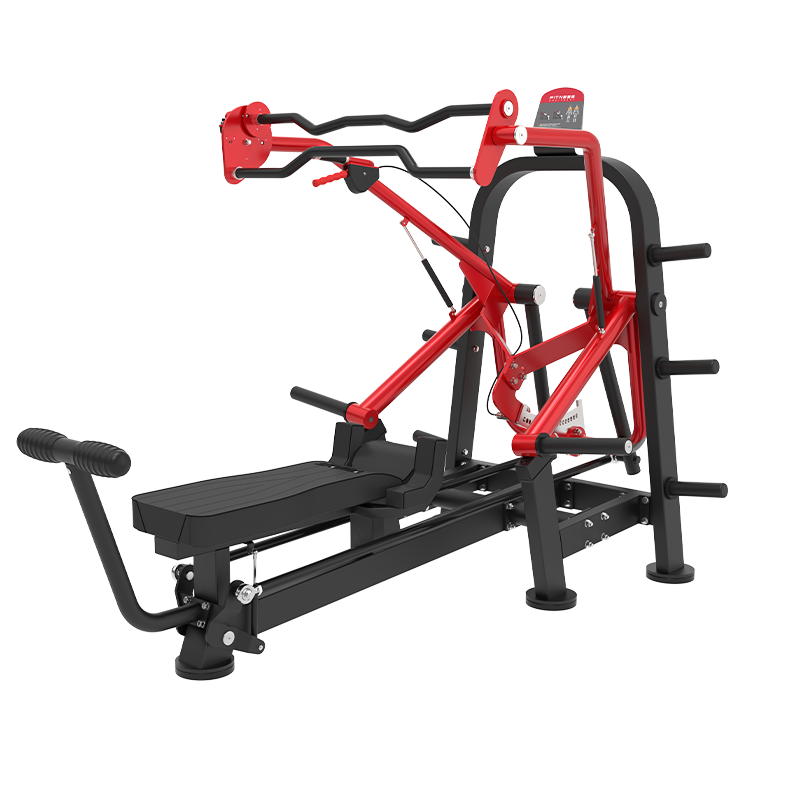
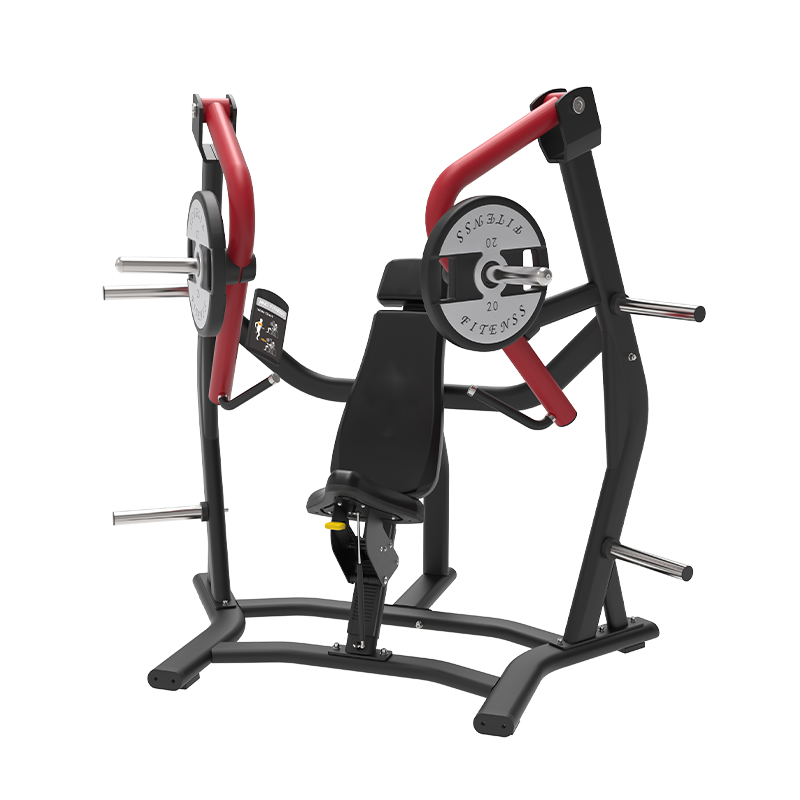
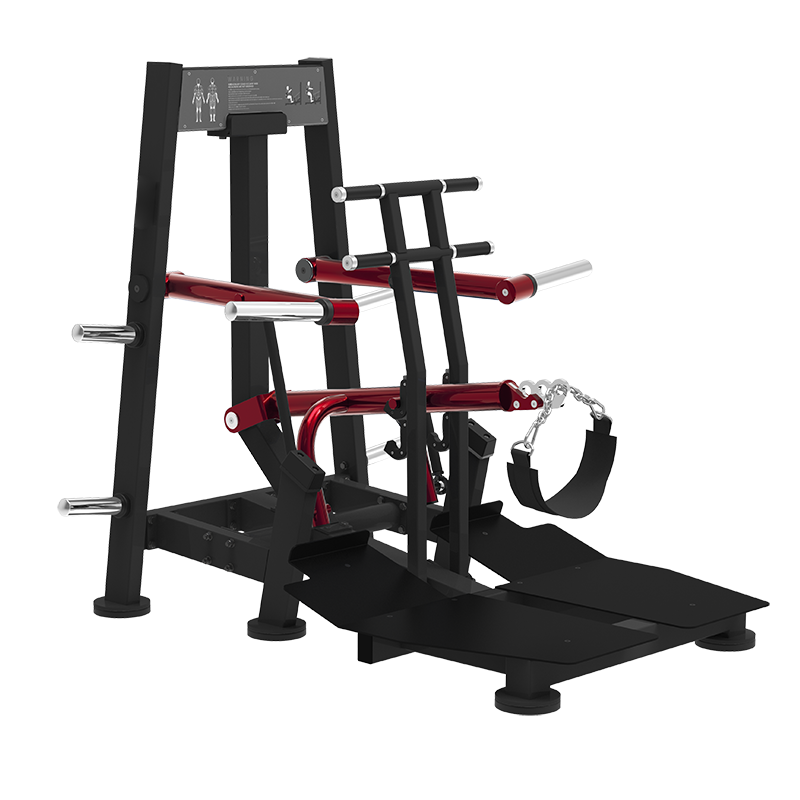
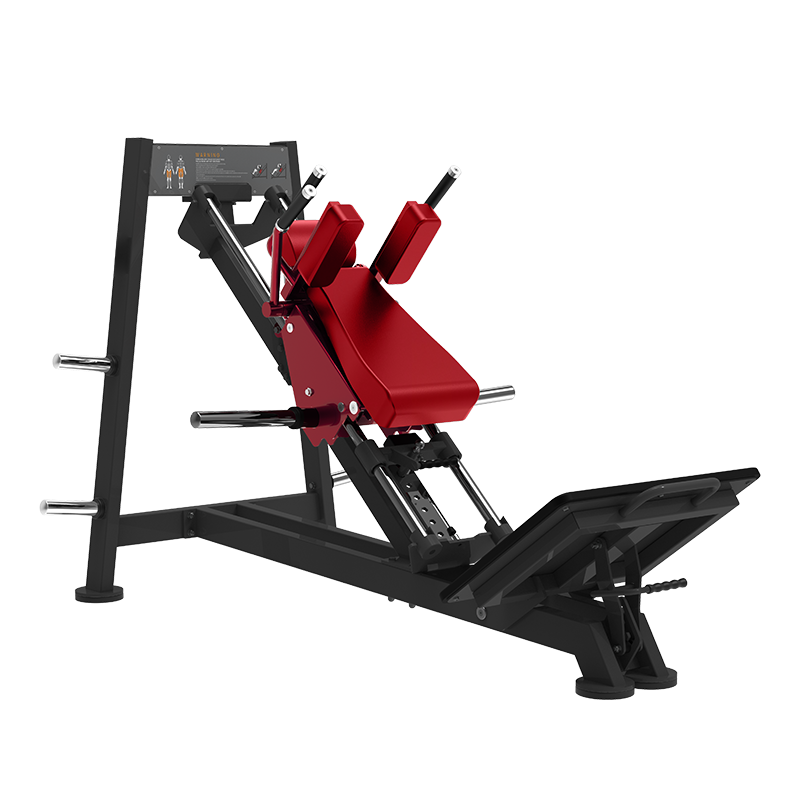
Based on the product details provided, this machine is a plate-loaded lower-body strength machine with a heavy-duty welded steel frame, black powder-coated finish, and red upholstered support pads. The visible layout suggests a slanted main carriage or track, a pivoting resistance arm, adjustable start or stop points, and a large angled foot platform. Side-mounted plate storage pegs are also visible, which is a small detail that can make a big difference in a busy training room.
The exact model name and mechanism are not supplied, so it is safest to describe it by function rather than over-specify it. It may serve as a standing or press-style lower-body station, and the available structure points to controlled loading for calf training, leg drive training, and bilateral or unilateral lower-body resistance work. For buyers, that means the machine is not just about one exercise. It is about the training envelope it creates.
Hack squat versus other lower-body machines
A hack squat machine usually fills a different role than a leg press or a pendulum squat. The hack squat pattern generally places the torso at a more fixed angle, which can help users focus on the legs without fighting the balance demands of a free barbell squat. Compared with a traditional squat rack, it removes a few variables and adds a few of its own.
For a sourcing manager, the useful comparison is not which machine is “better” in the abstract. It is which one best matches the user base.
Where a hack squat-style machine can help
It can provide a guided movement path that some members find easier to learn than barbell squatting.
It can support heavier loading in a controlled format, which is useful for progressive lower body strength training.
It can encourage high-effort sets without requiring a spotter in the same way free weights often do.
It can serve commercial gyms, athletic facilities, and rehabilitation-oriented environments where repeatability matters.
Where buyers should be cautious
Not every hack squat geometry feels natural to every user. Foot platform angle, pad placement, and start position all affect comfort.
A machine can look sturdy yet still be awkward if the carriage path or shoulder support does not match a broad user range.
If the gym already has several leg stations, this machine should be added for a clear reason, not just because it is large and eye-catching.
Construction details that matter more than marketing
The product information points to welded steel fabrication with powder coating and foam-vinyl upholstery. That is standard language in commercial fitness equipment, but standards still vary in practice. In a heavy duty squat machine, the frame stiffness, the stability of the base feet, and the quality of adjustment hardware are what usually determine whether the machine holds up under repeated use.
Visible storage pegs are worth mentioning because they do more than save floor space. They also keep plates close to the machine, which helps reduce clutter and improves workflow on the training floor. In a busy gym, that is not a minor convenience. It affects how often the machine gets used and how easily staff can manage the area.
The angled foot platform is another meaningful detail. It influences stance width, pressure distribution, and how naturally the user can drive through the movement. For some athletes, a firmer, larger platform is one of the reasons they prefer a hack squat machine over a simpler press machine.
What buyers should evaluate before purchasing
If you are comparing machines for a commercial gym purchase, these are the points that deserve more attention than a glossy brochure.
1. Frame stability under real use
A machine may be plate-loaded, but the real concern is how it behaves when loaded repeatedly at the edge of its range. Look for a wide, floor-supported base and an overall layout that resists rocking. Rubberized feet are a positive sign, though they are not the whole story.
2. Ease of entry and exit
A lower-body machine should not feel like a climbing exercise before the workout starts. Start/stop positions and lock points are important, especially in facilities with mixed user populations.
3. Adjustment range
The product description mentions adjustable positions, which is encouraging. Buyers should confirm that the range supports different body sizes and training styles. A commercial machine needs to accommodate more than one “ideal” user.
4. Plate loading and storage behavior
Plate-loaded equipment is attractive for its rugged simplicity, but only if the loading process is smooth and safe. Storage pegs are helpful, yet they should not interfere with the user path.
5. Upholstery and contact points
Pads that are too firm can feel unforgiving; pads that are too soft may wear poorly or shift under load. The red upholstered pads on this unit suggest a conventional commercial approach, but buyers should still ask about long-term cleaning and replacement support.
How facilities use this type of machine
In a strength club or high-traffic gym, a Super Hack Squat can slot into several programming needs.
For athletes, it can support leg drive work, especially when coaches want a repeatable lower-body loading pattern without the noise and space demands of a barbell setup.
For general members, it is often a confidence-building station. Many lifters who hesitate under a barbell are more willing to push a hard set on a guided machine.
For rehabilitation or return-to-training environments, the value is control. That does not mean the machine is automatically suitable for rehab use; it means the movement is easier to scale and monitor than a free squat in many cases.
For bodybuilders and strength-focused users, the attraction is simple: hard sets, limited setup time, and a movement that keeps tension where they want it.
Common buying mistakes
One mistake is buying a large machine for the visual impact alone. A heavy frame does not automatically mean better biomechanics.
Another is assuming every plate-loaded lower-body machine functions the same way. Small differences in track angle, pad position, and footplate geometry can change the exercise enough that some users will love it and others will avoid it.
A third mistake is ignoring service access. Commercial equipment needs cleaning, inspection, and occasional part replacement. If the machine is hard to inspect around the carriage or adjustment points, that becomes a maintenance issue later.
Why manufacturer capability matters
Shandong Minolta Fitness Equipment Co., Ltd. brings a useful manufacturing profile to this kind of product discussion. The company states that it has over a decade of experience in fitness equipment, a facility spanning 120,000 square meters, and more than 300 types of exercise equipment across commercial and home categories. It also reports exports to more than 100 countries across Europe, Africa, the Middle East, South America, and Southeast Asia.
For buyers, that does not replace a technical review of the machine itself, but it does give context. A supplier with broad commercial equipment experience is more likely to understand the demands of welded steel fabrication, repeated loading, and floor-level stability in busy training spaces. Still, the buyer should ask for the exact model specification, dimensions, load limits, and adjustment details before making a final decision.
Practical selection advice for sourcing teams
If you are evaluating a Super Hack Squat for procurement, start with the user profile. A strength facility serving athletes will value different characteristics than a hotel gym or a rehabilitation center. Then check whether the machine adds a function the room does not already cover.
If you already have a leg press, a hack squat machine may still make sense because it changes the loading angle and user experience. If space is tight, though, a machine should earn its footprint with clear training overlap rather than novelty.
It is also worth asking for photos or video of the carriage movement, adjustment operation, and loading process. Those three things often reveal more than a spec sheet.
FAQ
Is a Super Hack Squat only for quads?
Not necessarily. The exact muscle emphasis depends on stance, depth, and machine geometry. Many users feel it strongly in the quads, but it can also support glute and hamstring training depending on how it is used.
Is plate-loaded equipment harder to manage in a commercial gym?
It can be, but not if the machine is designed well. Plate storage pegs and a stable frame help a lot. The main issue is usually organization, not the loading concept itself.
Should a gym choose this over a standard squat rack?
That depends on your audience. A squat rack is more versatile for free-weight training. A Super Hack Squat gives guided lower-body loading and may be better for users who want structure, higher volume, or less setup complexity.
What should a buyer confirm with the supplier?
Confirm the exact exercise function, dimensions, load rating, adjustment range, and service support. Do not assume from appearance alone.
Next step for buyers
If your facility is building out a commercial lower-body zone, this kind of machine deserves a close look. Ask for the detailed specification sheet, movement photos, and finish options, then compare it against the training needs of your members rather than against marketing language. A Super Hack Squat can be a strong addition, but only when the geometry, build quality, and room layout all line up with the way your users actually train.
For sourcing teams, that is usually the difference between a machine that sits on the floor and one that stays busy.