


Why a Wide Chest Press Still Earns Floor Space in Busy Gyms
A Wide Chest Press is one of those pieces that looks straightforward until you watch how many members use it differently. Some load it heavy and treat it as a strength builder. Others prefer the supported seated position because it takes the lower back out of the equation. In a commercial setting, that matters. A machine that can serve multiple training goals without demanding much coaching time is usually a better buying decision than a flashy unit that sits idle.
For sourcing teams, the real question is not whether a Wide Chest Press Machine can press weight. It is whether the structure, loading style, and user setup fit your space, your audience, and your maintenance expectations. Plate-loaded leverage machines are especially common in commercial gyms because they give a natural pressing feel while avoiding the complexity of a selectorized stack. The trade-off is obvious: users must handle plates, and operators must think about storage, floor loading, and wear at the pivots.
What This Type of Chest Press Is Designed to Do
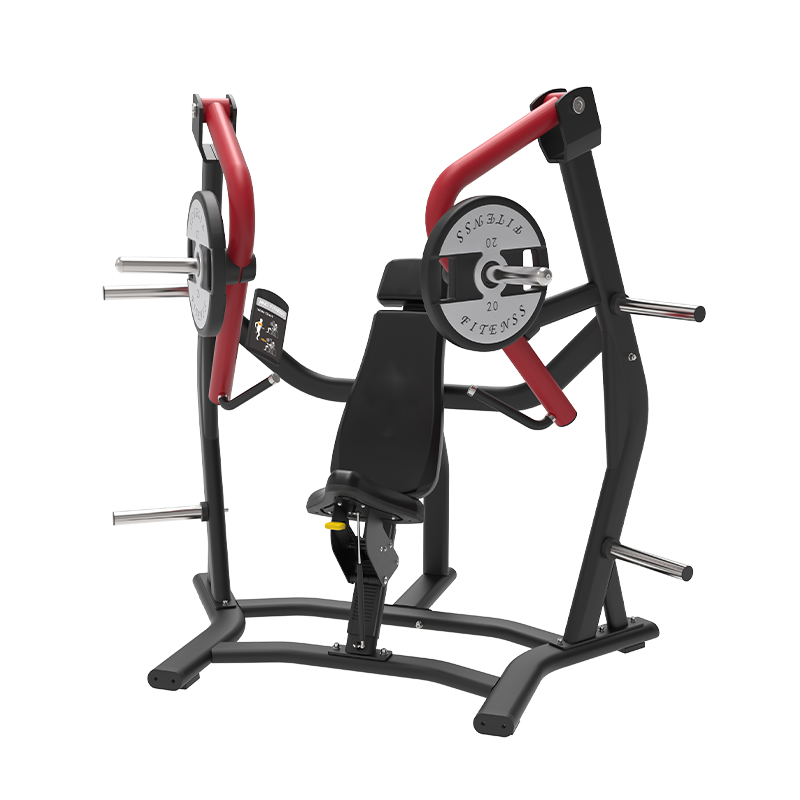
The machine described here is a plate-loaded chest press with a seated, supported pressing position. That puts it in the same family as a Chest Press Machine or Pec Press Machine, but the wider handle path and press-arm geometry are what often make buyers describe it as a Wide Chest Press. It is intended for chest, shoulder, and triceps work, with the seat and back pad helping stabilize the torso during the movement.
The visible construction points to a heavy welded steel frame with a matte black powder-coated finish, red curved press arms, and chrome or steel loading pegs on both sides. That combination is common in commercial strength equipment because it balances durability with a clean, easy-to-maintain appearance. The floor-mounted base and stabilizing feet also suggest the unit is built to stay planted during repeated loading cycles, not to be moved around the room every day.
Quick Buyer Takeaways Before You Compare Models
When buyers evaluate a Wide Chest Press Exercise, the first pass should be practical rather than technical. Does the user sit comfortably into the pad? Can plates be loaded without awkward lifting? Is there enough clearance for the arms to move freely? Those details often matter more than a marketing claim about “power” or “explosive training.”
For a commercial gym, plate-loaded equipment usually makes sense when the facility already has Olympic plates in circulation and staff can keep the area organized. For a hotel gym or rehabilitation-oriented training space, the same machine can work well if the resistance progression is manageable and the footprint is acceptable. Home gyms can also use this category, but only when the owner has the ceiling height, floor space, and plate storage to match.
How the Machine’s Structure Affects Daily Use
Seated support changes the training feel
A supported press removes a lot of the body sway you see with free-weight pressing. That helps newer users, and it reduces the need for coaching. It also makes the machine easier to slot into a circuit or general fitness floor where not every member knows how to bench press safely. The downside is that users who want a very free, barbell-like path may find it less natural. That is not a fault; it is simply the nature of machine-guided movement.
Independent-looking arms and leverage geometry
The unit uses dual pressing arms with rotating load horns. Whether those arms are mechanically linked or function independently is not confirmed from the available information, so a buyer should verify that point directly. It matters because linked arms and independent arms create different training experiences. Independent motion can help address side-to-side imbalance, while linked motion may feel more familiar and stable to some users. Either way, the pivot quality and bearing fit are critical. Sloppy joints show up quickly in commercial use.
Plate-loaded versus stack-loaded
A plate-loaded design is more flexible for facilities that already manage free weights. It also tends to have a rugged, straightforward service profile. There is no selector pin, weight stack, or cable routing to maintain. On the other hand, it is not as quick to adjust between users. That is the trade: more loading effort, less mechanical complexity.
Where a Wide Chest Press Fits Best
In commercial fitness centers, this machine usually belongs near other upper-body strength stations, ideally with clear plate storage nearby. The seated press format is especially useful during peak hours because it is easy to learn and doesn’t require a spotter in the way a barbell bench press might. Hotel gyms often appreciate the same feature set, though footprint and noise control become more important in those settings.
In rehab or strength-assistance areas, the supported position can be useful as long as the resistance range is appropriate and the user can enter and exit the machine safely. For home gyms, the main issue is not performance but logistics. A plate-loaded commercial machine asks for more room than many buyers expect, and it is worth checking the door paths before the purchase order is signed.
What to Check When Comparing Suppliers
Some details are visible on the machine itself, but several important items are not. The exact steel gauge, total machine weight, max user load, resistance ratio, seat adjustment range, and dimensions are not confirmed here. Those should be requested in the spec sheet, not guessed at. A polished product photo can hide a lot.
Buyers should ask for weld detail photos, pivot construction information, finish type, and packaging method. For a commercial machine, the quality of the frame welds and the consistency of the powder coat often tell you more about long-term reliability than promotional language ever will. Also ask how the loading pegs are finished. Poorly machined horns can scratch plates and wear badly over time.
If the unit will be used in a public gym, it is also worth checking whether replacement pads, foot caps, and bushings are available. Small service parts are easy to ignore during procurement, then hard to source after installation.
Manufacturing Factors That Separate a Durable Unit from a Short-Lived One
Shandong Minolta Fitness Equipment Co., Ltd. operates from Ningjin, a region known for hardware and fitness equipment manufacturing. The company says its facility covers 120,000 square meters and includes a manufacturing workshop, quality control lab, and exhibition hall. It also notes more than a decade of industry experience and a catalog of over 300 exercise equipment types across cardio and strength lines. For buyers, that signals a supplier with the scale to handle commercial orders, though the usual procurement checks still apply.
For a welded steel machine like this Wide Chest Press, the core manufacturing issues are familiar: tube forming accuracy, weld consistency, machining at the pivots, surface preparation before coating, and the durability of contact points where load is repeated daily. If those areas are handled well, the machine usually ages gracefully. If they are not, the first signs of trouble are rarely dramatic. You get squeaks, finish wear, loose arm movement, and eventually downtime.
Common Mistakes Buyers Make
One common mistake is buying purely on appearance. A matte black frame and bright red arms look strong in a showroom, but the real story is in the geometry and the hardware. Another mistake is forgetting that plate-loaded equipment needs plate management. If the gym already struggles with bumper plate clutter, adding another plate-loaded station without a storage plan will create friction for users and staff alike.
A third mistake is assuming all chest press machines feel the same. They do not. Handle angle, seat height, backrest position, and arm path all change the movement pattern. Even small differences can determine whether users feel the press in the chest or dump the load into the shoulders. That is why a test session matters before volume ordering.
Practical Advice for Sourcing Teams
If you are comparing a Wide Chest Press Machine against other upper-body options, make the decision around user mix, available floor area, and maintenance capacity. Facilities with strong lifting traffic and organized plate storage often benefit from plate-loaded leverage machines because they are durable and familiar to serious users. Facilities with a more general population may still choose the same machine, but only if the movement is easy to understand and the setup is forgiving.
Ask for dimensions, loading side clearance, and the seat adjustment range early. Those measurements often decide whether the machine will fit where you planned or force a floor layout revision. And if the machine will be installed on a platform, note the footprint of both the base frame and the loading zone. A chest press that technically fits can still feel cramped if people cannot walk around it.
What to Ask Before You Place an Order
Before you approve a chest press purchase, ask five basic questions: How is the arm motion configured? What is the exact loading method? What are the frame and coating specifications? Which parts are serviceable? And what space is needed for safe use and plate access? None of these questions are glamorous, but they prevent expensive surprises later.
If the supplier can provide clear answers and detailed drawings, that is usually a better sign than a long list of marketing adjectives. Minolta’s broader strength and cardio catalog suggests it supports commercial gym planning across categories, which can be useful if you want to keep sourcing consistent across multiple machines. Still, every machine should be evaluated on its own build quality and fit for purpose.
A Final Word for Buyers Who Want the Right Fit, Not Just the Right Price
A Wide Chest Press is a sensible purchase when you want a durable, easy-to-use upper-body station that works in commercial settings and still feels serious enough for strength training. The plate-loaded format gives it staying power, but it also asks more from layout planning and user management than a compact selectorized unit.
If you are comparing options now, the next step is to request the detailed specification sheet, confirm the arm configuration, and check how the machine will integrate with your plate inventory and floor plan. For procurement teams, that is usually where the real decision gets made.