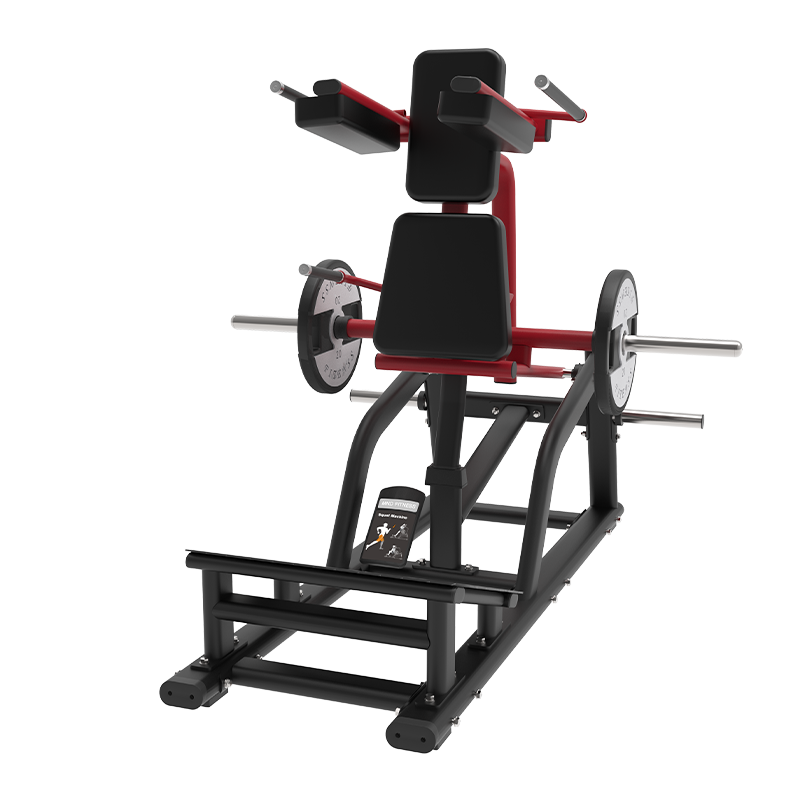



Lower-body compound stations dictate member traffic flow and retention more than almost any other zone on a commercial gym floor. When lifters queue for leg training, their choices usually collapse into two extremes: free-weight squat racks that intimidate novice lifters and monopolize floor space, or linear 45-degree leg presses that often cause pelvic tilt under heavy loads. The MND PL31 V Squat Machine addresses this specific floor-planning dilemma by offering an arc-driven, plate-loaded squatting trajectory designed to deliver heavy axial loading without the shear forces typical of locked linear rails.
For gym owners, franchise operators, and equipment procurement managers, evaluating a piece like the PL31 involves more than checking an upholstery swatch or confirming footprint dimensions. Plate-loaded leverage equipment operates under brutal, daily mechanical punishment. Understanding how the pivot geometry behaves, how the frame handles asymmetrical plate loading, and how the unit fits into a broader equipment mix is critical before issuing a purchase order.
The Biomechanical Argument: Arc Motion vs. Linear Hack Squats
To justify putting a dedicated V-squat on your floor, it helps to understand why lifters seek it out over a standard linear hack squat. A traditional hack squat slides along fixed linear bearings or nylon rollers at a constant 45-degree incline. While effective for quad isolation, that rigid vector locks the ankles and hips into a single plane, frequently irritating knees if a lifter's femur length or ankle dorsiflexion deviates from the machine's fixed angle.
A machine like the MND PL31 operates on a fixed heavy-duty pivot point, creating a natural curved movement arc. As the user descends, the platform angle and shoulder pad assembly shift slightly in space, mirroring the natural rearward hip translation of a standard barbell back squat. This movement path offers distinct operational advantages on the gym floor:
- Reduced Lumbar Shear: The curved trajectory keeps the user's center of gravity planted securely through their heels and midfoot, dramatically reducing lower-back rounding at the bottom of the descent.
- Dual-Orientation Training: Members can perform front-facing squats (mimicking a hack squat setup) or turn around for reverse-facing squats (mimicking a traditional low-bar or good-morning hinge movement). This versatility effectively turns one footprint into two distinct training stations.
- Joint Accessibility: Lifters recovering from patellar tendinitis or hip impingements who cannot tolerate standard barbell squatting often find the leverage arc of a V-squat significantly more forgiving.
Structural Engineering and Hardware Demands
Leverage units live and die by their pivot assemblies and structural steel thickness. When you invest in a V squat machine commercial gym owners must anticipate worst-case loading scenarios: advanced lifters loading five or six 20kg Olympic plates per horn, combined with explosive eccentric-to-concentric transitions.
Shandong Minolta Fitness Equipment Co., Ltd. (operating globally as MND FITNESS) manufactures units like the PL31 out of Ningjin County's established industrial hardware corridor. With a manufacturing facility spanning 120,000 square meters housing complete machining, welding, and quality inspection workshops, the mechanical integrity of heavy plate-loaded lines benefits directly from local industrial metalworking supply chains.
When reviewing technical specifications for this class of machine, pay close attention to three engineering points:
1. The Main Pivot Bearing Block
A leverage arm carrying hundreds of kilograms cannot rely on basic bushing sleeves. It requires industrial-grade pillow-block bearings or heavy sealed spherical roller bearings capable of handling rotational torque and lateral play. If the main pivot deflects even two millimeters under uneven plate loads, the carriage binds, generating uneven friction that members immediately feel as a "sticking point" mid-rep.
2. Footplate Dimensions and Surface Treatment
The footplate on the MND PL31 must accommodate both wide-stance sumo setups and narrow quad-focused foot placements, as well as the reverse-facing stance. An undersized diamond-plate deck forces lifters into compromised foot angles. Look for an oversized, multi-angle checker-plate steel base that provides dependable traction even when damp with sweat.
3. Mechanical Safety Stops
Commercial gym safety hinges on fail-safes that do not require complex thought under muscular failure. An intuitive, multi-position lockout handle that disengages smoothly at the top of the movement and catches reliably when racked mid-descent is non-negotiable for unattended strength training zones.
Floor Plan Logistics: Space, Clearances, and Plate Storage
A common procurement misstep is measuring only the outer footprint of the steel frame while forgetting operating clearances. The MND PL31 V Squat Machine requires adequate space not just for its physical frame, but for the full sweep of the weight horns and the operational zone needed for loading and unloading standard 450mm Olympic plates.
| Planning Variable | Minimum Practical Clearance | Why It Matters |
|---|---|---|
| Lateral Plate Loading Zone | 600 mm on each side | Prevents members from bumping into adjacent machines while carrying 20kg plates. |
| Vertical Overhead Clearance | 2,300 mm minimum | Accommodates tall lifters standing upright at full lockout without head pad collision. |
| Rear Pivot Clearance | 300 mm from back wall | Prevents counterweights or rear structural gussets from scratching facility walls. |
Integrated weight plate storage pins are a major asset on the gym floor. They reduce plate scatter and save purchasing standalone plate trees, but make sure your team accounts for the added structural width when mapping your layout tape on the floor.
Sourcing from Experienced Manufacturers
Sourcing heavy strength pieces internationally requires looking closely at factory capabilities. MND FITNESS brings over a decade of dedicated production experience to commercial fitness sectors, exporting strength lines—from selectorized platforms like their MND-AN and MND-G lines to dedicated plate-loaded units—to commercial facilities across more than 100 countries in Europe, South America, the Middle East, and Southeast Asia.
When dealing with overseas container orders, a key variable is the knock-down design. Fully welded sub-assemblies ensure frame rigidity, but shipping massive leverage arms across oceans demands smart modular packaging. Sourcing teams should verify that critical stress nodes utilize heavy gauge tubing, high-durability electrostatic powder coating to prevent corrosion in humid environments, and high-density industrial foam padding wrapped in sweat-resistant, tear-resistant vinyl upholstery.
Maintenance Best Practices for High-Traffic Facilities
While plate-loaded machines require substantially less upkeep than cable-and-pulley selectorized stations, neglect will still result in member complaints and premature wear. Establish a basic preventive maintenance routine for your floor team:
Weekly: Wipe down upholstery seams with neutral disinfectant. Avoid harsh solvent cleaners that break down marine-grade vinyl over time. Inspect the lockout safety catch to ensure springs engage smoothly without sticking.
Monthly: Check the torque on all structural assembly bolts. Vibration from heavy plate drops can gradually loosen secondary frame hardware. Inspect the plate-loading horn sleeves for burrs or peeling chrome caused by steel plate inserts.
Quarterly: Inspect the primary pivot bearings. Sealed cartridge units rarely require active lubrication, but any lateral wiggle or grinding noise indicates bearing race wear that demands immediate replacement before the main frame sustains bore damage.
Frequently Asked Questions
Can the MND PL31 accommodate users of varying heights comfortably?
Yes. Because the machine pivots on an arc rather than sliding inside a fixed box frame, lifters from roughly 155 cm to over 195 cm can find a comfortable setup simply by adjusting their foot placement forward or backward on the oversized platform and engaging the shoulder pads at their natural standing height.
Is a V-squat redundant if our gym already has multiple 45-degree leg presses?
Not at all. A 45-degree leg press stabilizes the torso completely against an angled backrest, keeping the core relatively passive. A V-squat loads the shoulder girdle and engages the spinal erectors, glutes, and core musculature in an upright, functional standing position—giving lifters a genuine closed-chain squat stimulus without needing a spotter.
What floor anchoring is recommended for this machine?
While the machine's heavy tare weight and broad base keep it stable under standard conditions, high-volume commercial facilities should always bolt heavy leverage stations directly to the concrete subfloor using expansion anchors, particularly if advanced lifters will be performing explosive reverse squats.
Next Steps for Facility Planners
Selecting the right heavy-compound leg machine balances floor safety, movement versatility, and fabrication toughness. When specifying a V squat machine commercial gym installations will rely on day after day, request detailed frame tube specifications, exploded hardware diagrams, and factory container loading configurations directly from your equipment representative before confirming your floor plan.