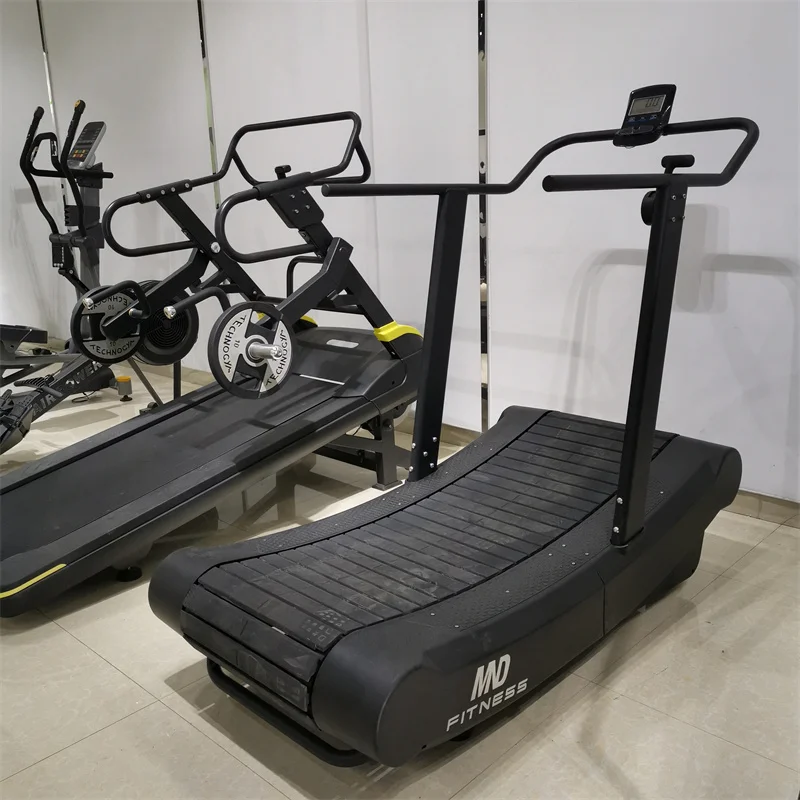



Commercial gym operators and athletic training facilities have spent the past several years quietly clearing floor space once dominated by motorized decks. The push toward non-motorized, self-powered running platforms is driven by practical business concerns: zero electrical drop costs, drastically reduced motor maintenance, and high athlete engagement during metabolic conditioning. In this segment, the MND-Y600A curved treadmill has emerged as a distinct commercial contender, especially for procurement teams evaluating slat-belt durability under heavy rotational torque. Sourcing such equipment, however, requires looking past marketing claims to examine slat substrate integrity, braking mechanisms, and the physical reality of freight and assembly.
The Slat Deck: Why Belt Metallurgy Dictates Longevity
Traditional flat treadmills rely on a continuous synthetic belt pulled across a waxed phenolic deck board. This system generates friction, heat, and predictable wear on drive motors and deck wax. Curved, non-motorized runners operate on an entirely different mechanical principle: precision low-friction ball bearings carry a segmented slat belt along a fixed concave arc. But not all slat designs survive commercial abuse.
Low-tier commercial decks frequently use molded polyurethane or polycarbonate composite slats. Under standard running, these hold up reasonably well. However, when an athletic facility incorporates sled-push intervals or heavy sprint stops, composite slats can deflect, crack along the bolt bosses, or deform under concentrated foot-strike shear. An aluminum alloy belt treadmill addresses this structural weak point by using extruded aluminum bars as the load-bearing spine of each slat.
On high-spec units like the MND-Y600A, manufacturers pair this rigid backbone with an elastomeric tread, creating a rubber and aluminum alloy running belt. The extruded aluminum profile provides the torsional rigidity needed to prevent lateral deflection along the guide rails, while the vulcanized rubber upper dampens foot impact and delivers reliable grip under wet, high-sweat training conditions. For procurement teams calculating total cost of ownership, opting for a curved treadmill aluminum alloy belt eliminates the recurring headache of brittle slat replacement common with all-plastic tracks.
Magnetic Braking and Training Versatility
Early iterations of non-motorized curved runners lacked variable resistance; the speed of the belt was governed purely by user cadence and center-of-mass placement on the arc. While effective for distance pacing and pure sprint intervals, this one-dimensional dynamic limited the utility of the machine for broad strength and conditioning programming.
Modern commercial specifications increasingly demand a magnetic brake curved treadmill configuration. Rather than utilizing friction pads that generate heat and require periodic re-tensioning, magnetic systems rely on an array of permanent neodymium magnets interacting with a conductive rotor or the metallic elements of the belt assembly to generate eddy currents. Adjusting the proximity of these magnets alters the drag without surface-to-surface mechanical contact.
Incorporating a reliable magnetic resistance adjustment treadmill platform expands floor programming significantly. At zero or low resistance, the athlete experiences an ultra-smooth, low-inertia glide ideal for top-end speed mechanics. Dialing up the resistance transforms the platform into an effective sled-simulation station. Athletes can lean into the front handrail and perform high-resistance power marches that heavily recruit the posterior chain—all without taking up 30 meters of dedicated indoor turf. It is worth noting, however, that magnetic resistance linkages must feature solid mechanical detents; cheaper cable-actuated levers often slip out of setting under intense platform vibration.
Evaluating the MND-Y600A Curved Treadmill Specification
When reviewing any commercial curved treadmill specification sheet, the numbers tell only half the story. The mechanical execution of the chassis dictates whether the unit will remain quiet after six months of cross-training sessions. The MND-Y600A is built around a heavy-gauge tubular steel base, designed to anchor the machine firmly without floor anchors.
- Deck Curvature: Engineered with a moderate arc profile that balances rapid acceleration for sprinters with a stable footstrike zone for steady-state recovery runs.
- Belt Assembly: Segmented rubberized aluminum slats riding on sealed commercial-grade bearings, sealed against sweat intrusion and fine dust.
- Resistance Control: Multi-position manual magnetic adjustment lever positioned within easy reach during mid-stride drills.
- Display Telemetry: Self-powered battery console tracking pace, distance, heart rate, and interval work/rest cycles, eliminating the need for trailing floor cables.
- Mobility: Integrated rear transport handle paired with heavy-duty front polyurethane rollers, allowing gym floor staff to reconfigure layouts quickly.
Freight, Crating, and Doorway Clearances
Logistics is where many commercial gym installations hit unexpected friction. Non-motorized curved units do not fold, and their welded chassis structure means they arrive in substantial, rigid packaging. A standard specification to account for is the curved treadmill packing size 1800x1000x560 mm.
A shipping crate spanning 1.8 meters in length and a full meter in width will not slide through standard single-leaf doorways or navigate tight residential/commercial stairwells without prior de-crating. Sourcing managers must plan ingress paths: verify service elevator interior depth, double-door entries, and freight dock offloading capabilities. Furthermore, when ordering full container loads (FCL), the 1800x1000x560 mm dimensions require careful volumetric planning to optimize floor stacking inside 40ft High Cube containers without exceeding vertical crush limits on wooden shipping pallets.
Manufacturer Ecosystem: Sourcing from Ningjin Industrial Base
The manufacturing origin of a curved treadmill training machine often reveals its structural pedigree. The MND-Y600A is manufactured by Shandong Minolta Fitness Equipment Co., Ltd., operating from the recognized hardware and fitness fabrication cluster of Ningjin County, China. With over a decade of production history and a facility footprint covering roughly 120,000 square meters, the company integrates large-scale metal cutting, precision welding, and electrostatic powder-coating under centralized quality control.
For international buyers, sourcing MND fitness equipment provides two practical advantages: access to standardized regional hardware supply chains (ensuring spare parts like pillow blocks, custom bearings, and fasteners remain available years after installation) and factory-direct access to engineering revisions. When vetting commercial suppliers, buyers should routinely ask how replacement slat segments are ordered and packed, as having 5 to 10 spare slats on a shelf is far smarter than waiting on international air freight for a single damaged slat down the road.
Common Buyer Pitfalls to Avoid
Procuring curved manual treadmills involves distinct checks that standard motorized treadmill evaluations do not cover:
- Ignoring Bearing Ingress Protection: Because curved units have no motor cover to deflect sweat, sweat drips directly into the track channel. Ensure the guide bearings are sealed (RS or 2RS spec) rather than open or simple shielded (ZZ) types.
- Overlooking Track Alignment Systems: Aluminum slats must track perfectly true. Ask the supplier about the mechanical tensioning bolts located at the rear axle and whether alignment can be adjusted without tearing down the side cowlings.
- Underestimating User Transition Time: Athletes unfamiliar with curved manual decks tend to over-stride or strike too high on the curve, causing abrupt acceleration. Staff must be trained to instruct users on finding their neutral pace pocket at the bottom of the arc.
Frequently Asked Questions
Does an aluminum alloy slat belt require deck lubrication?
No. Unlike traditional PVC running belts that slide against a deck board, curved slat systems ride entirely on rolling-element bearings. Liquid silicones or wax should never be applied to the aluminum slat track, as lubrication attracts rubber dust and gym grime, which can gum up bearing tracks and degrade magnetic braking surfaces.
How noticeable is the difference between composite and aluminum slats underfoot?
Athletes immediately perceive aluminum-backed slats as firmer and more responsive, closely mimicking outdoor sprint track surfaces. There is virtually zero spongy rebound, which reduces energy loss during acceleration phases. The rubber outer skin prevents shoe slippage while dampening sound vibration.
What routine maintenance does the MND-Y600A require?
Maintenance is minimal compared to motorized units. Weekly tasks consist of wiping down the rubber slats and vacuuming debris from the lower chassis pan. Quarterly maintenance involves checking track alignment, verifying hardware torque on handrail uprights, and inspecting the magnetic resistance control cable for smooth actuation.
Next Steps for Procurement Teams
If you are drafting equipment tenders for a performance gym, CrossFit affiliate, or commercial franchise rollout, request detailed exploded parts diagrams and CBM calculations for the MND-Y600A. Verify your facility door dimensions against the crated dimensions prior to dispatch, and discuss spare slat and bearing kit inclusions directly with the factory sales team to secure consistent long-term operational uptime.