


Rethinking Lower-Body Loading: The Commercial Sourcing Case for Belt Squats
For commercial strength facilities, sports science institutes, and large-scale training centers, spinal compression remains the single biggest bottleneck in high-volume lower-body training. Athletes, rehabilitation patients, and general gym members frequently reach a point where spinal fatigue dictates the end of a session long before the quadriceps and glutes are fully exhausted. This biomechanical dilemma is precisely why the plate loaded hip belt squat has shifted from an obscure powerlifting novelty into a staple on modern gym floor plans.
From an equipment procurement perspective, sourcing a belt squat machine requires balancing heavy load capacity with mechanical simplicity. Unlike cable-driven or selectorized variants that introduce complex pulley maintenance, a plate-loaded system leverages straightforward leverage mechanics. However, because the entire payload hangs directly from the trainee's pelvic girdle via a belt, the frame geometry, pivot assembly, and deck stability demand careful evaluation. Getting the mechanical leverage wrong results in awkward shear forces across the knees or hips, turning a tool meant for joint preservation into a liability.
Biomechanical Principles: Deloading the Spine Without Deloading the Legs
The engineering premise of a plate loaded hip belt squat machine centers on bypassing the axial skeleton entirely. In a conventional barbell back squat, the compressive load travels downward through the cervical and lumbar spine, sacroiliac joint, and hips before reaching the femur. For users managing disc herniations, structural back strain, or shoulder mobility deficits that prevent holding a barbell, traditional squatting simply ceases to be an option.
When the load is anchored to a belt at the waist, the vertical force line passes directly through the hips and knees. This mechanical alteration yields specific physiological advantages:
- Elimination of Upper-Body Stabilizer Fatigue: Athletes can squat to absolute muscular failure without worrying about upper-back collapse or losing core rigidity.
- Traction Effect on the Lumbar Region: The downward pull of the belt can create a mild distractive force on the lower spine during the descent, alleviating back pressure rather than compounding it.
- True Stance Customization: Users can vary foot placement, hip width, and squat depth freely without the risk of spinal flexion under load.
Key Engineering and Manufacturing Specifications to Inspect
Not all plate-loaded frames are engineered to survive commercial volume. Sourcing managers should inspect several specific structural components prior to issuing a purchase order.
1. Pivot Axles and Bearing Configurations
The lever arm on a belt squat experiences substantial rotational torque, especially when loaded with hundreds of kilograms of Olympic plates. Budget machines often rely on simple nylon bushings that wear out quickly under asymmetrical loading, resulting in lateral play and squeaking. Industrial commercial units utilize heavy-duty, sealed pillow block bearings or deep-groove ball bearings mounted within a machined housing. This ensures smooth, silent articulation regardless of whether the user drives symmetrically or shifts slightly off-center.
2. Footplate Width, Deck Clearance, and Stance Security
A frequent design flaw in lower-tier machinery is an undersized platform. A proper commercial belt squat requires a split or recessed platform design with enough width to accommodate wide-stance powerlifters and lateral lunges. Furthermore, the standing surface must feature aggressive diamond plating or textured slip-resistant coatings. When sweat accumulates on the platform, grip is the primary barrier between a secure lift and a severe slip under tension.
3. Leverage Curve and Plate Horn Placement
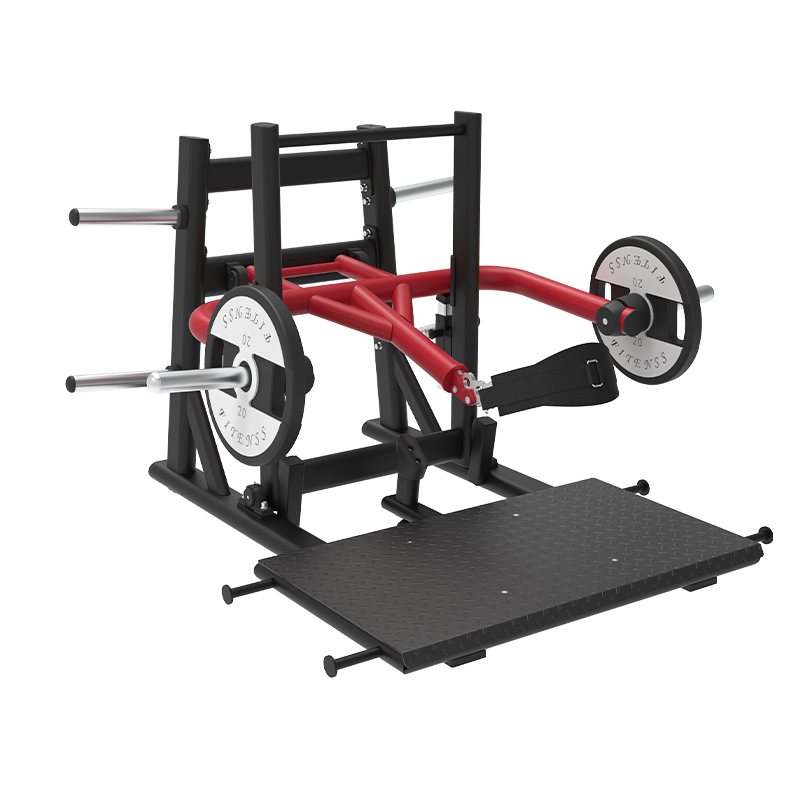
Because the load arm arcs along a fixed pivot, the resistance curve changes throughout the range of motion. Quality manufacturing accounts for this by positioning the weight horns to provide a balanced resistance curve that feels heavy out of the hole without dropping off drastically at the top lockout. Machines such as the MND PL74 Hip Belt Squat Machine integrate balanced leverage points designed to match natural lower-body strength curves while maintaining ample plate horn sleeve length for thick rubber bumper plates.
4. Safety Lockout Mechanism
Unlike a leg press where a safety catch might be engaged with foot levers, a belt squat requires an easily accessible hand-operated release lever. The user must be able to hook their belt into the carabiner, stand up to disengage the stop, complete their set, and re-engage the catch without bending down into a compromised lumbar position when fatigued. Look for drop-in lockout pins or positive-locking swing arms fabricated from thick-gauge steel.
The Manufacturing Base: Heavy Hardware from Ningjin
When procuring heavy commercial strength lines, identifying the production background provides insight into long-term durability. Shandong Minolta Fitness Equipment Co., Ltd. (MND FITNESS) manufactures out of Ningjin, a region in China known for its extensive hardware and industrial manufacturing cluster. With a facility covering 120,000 square meters housing comprehensive fabrication lines, quality control testing, and large-scale metal forming, MND FITNESS focuses heavily on plate-loaded structural integrity.
Having exported fitness equipment across Europe, the Middle East, South America, and Africa, Minolta applies standard structural steel tubing and electrostatic powder coating to withstand diverse operational environments. For gym builders configuring specialized lower-body zones, the MND PL74 Hip Belt Squat Machine represents an accessible, high-durability option within commercial plate-loaded strength equipment, offering the rigid base and dependable lockout mechanisms demanded by commercial facilities.
Common Procurement Mistakes When Sourcing Belt Squats
Before issuing requests for quotation (RFQs), procurement officers often miss small practical nuances that impact floor operations:
- Overlooking Floor Anchor Points: Because the user stands directly on the machine's base frame, some models do not strictly require bolting to the floor. However, if the machine features band pegs for accommodating resistance bands, aggressive dynamic loading can lift the rear chassis if it is not secured. Confirm whether floor anchor tabs are pre-welded onto the frame.
- Neglecting Belt and Carabiner Ratings: The machine is only as dependable as the harness connecting the user to the load arm. Supplying commercial-rated, multi-ring nylon or leather dipping belts rated for heavy working loads avoids immediate wear. Never use generic carabiners; specify rated industrial climbing or rigging hardware.
- Ignoring Loading Horn Clearance: Ensure the lateral clearance around the machine allows staff and users to load 450mm diameter Olympic plates comfortably without striking adjacent equipment or walls.
Buyer's Evaluation Guide: Key Questions to Ask Suppliers
When negotiating with commercial gym equipment manufacturers, use this quick checklist to separate light-duty units from commercial-grade options:
- What is the wall thickness and cross-section of the main structural steel tubing (e.g., 3mm / 11-gauge)?
- Does the pivot arm utilize sealed maintenance-free bearings or replaceable brass/bronze bushings?
- What is the maximum tested load rating for the plate horns?
- Does the machine design allow for belt hook-up adjustments to fit trainees ranging from 150 cm to over 195 cm in height?
- What surface treatment is used on high-wear parts like the weight horns and footplate?
Frequently Asked Questions
Can users perform exercises other than squats on a plate loaded hip belt squat?
Yes. A versatile commercial belt squat setup also accommodates hip thrusts, march steps, calf raises, bent-over rows, and split squats. If the machine includes integrated handrails, users have substantial stability to perform unilateral quad training safely.
How does maintenance compare between cable-based and plate-loaded belt squats?
Plate-loaded machines require significantly less routine maintenance. There are no aircraft cables to fray, pulleys to split, or weight stacks to clean and lubricate. Maintenance generally boils down to inspecting the pivot bearings biannually, checking hardware torque, and inspecting the belt harness for stitching wear.
Is the footprint of a belt squat machine manageable for mid-sized gyms?
While a belt squat has a wider profile than a standard power rack due to the lateral weight horns, it consolidates multiple training needs into one footprint. Because it eliminates the need for an overhead barbell clearance, it can safely sit beneath low ceilings or on mezzanine gym floors where overhead pressing or high rack uprights might not fit.
Next Steps for Facility Planning
Integrating a plate loaded hip belt squat into a commercial layout requires analyzing your floor traffic, typical member profile, and strength training zones. For specialized commercial facility fit-outs, examine detailed frame blueprints, review bearing specifications, and confirm steel tube sizing directly with your manufacturing partners. Reviewing technical specs for dedicated models like the MND PL74 Hip Belt Squat Machine ensures your investment provides the structural integrity, safety tolerances, and long service life your members rely on.