


Why a Pectoral-Machine Still Earns Floor Space in Commercial Gyms
A pectoral-machine looks simple at first glance, almost old-school, but that is exactly why it keeps showing up in commercial gyms, rehab corners, and training facilities that need reliable gym chest equipment. In a room full of racks, benches, and cable stations, a seated chest fly machine gives users one obvious path: sit down, set the pad height, take the handles, and move through a fixed arc that isolates the chest without asking for much technique.
For buyers, that simplicity matters. It affects how many members can use the machine safely, how much coaching staff need to intervene, and how often the station gets left idle because it feels too complicated or intimidating. A Pec Deck Machine is not the flashiest piece on the floor, but for pectoral training it can be one of the more useful, especially where the goal is controlled repetition rather than maximal load.
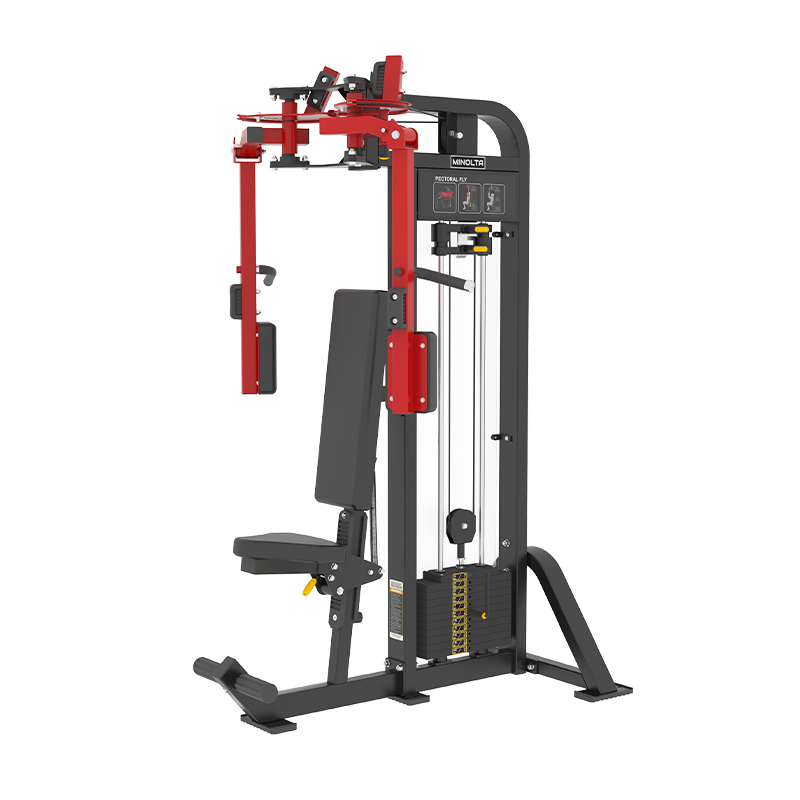
The unit described here appears to be a selectorized seated chest fly or pec deck strength machine with a central weight stack, dual upper arm handles, black upholstery, and a steel frame finished in black and red powder-coated sections. That mix is common in commercial gym equipment for a reason: it is compact, visually clear, and easy for members to understand from across the room.
What the Machine Is Designed to Do
At its core, this type of chest fly machine guides the arms through an inward hugging motion that targets the pectorals. Depending on the arm position and the exact cam or linkage design, some versions also allow a reverse motion or alternate setup that can involve the rear delts and upper back. The visible configuration suggests a seated frame with a fixed path, which usually makes the movement easier to learn than free-weight fly variations.
That does not mean it is a beginner-only tool. Many experienced lifters use a Pectoral Muscle Trainer to finish a chest session after pressing work, because the machine keeps tension steady and removes much of the balancing demand. In rehab-oriented strength areas, a controlled motion can also be useful when the facility wants a predictable path and a more forgiving setup than dumbbells or barbell flyes.
A practical note: machine chest flys are not a universal replacement for presses. They are an isolation tool, and they should be treated that way. That sounds obvious, but buyers sometimes overestimate what a single station can do for a program.
Quick Reference: What Buyers Usually Care About
The strongest features visible on this machine are the things gym operators notice fastest once it is on the floor:
- Seated fixed-path design for easy use and consistent movement
- Central weight stack that keeps resistance changes fast
- Adjustable seat and back support for different torso positions
- Dual-arm mechanism that should feel more natural than a single rigid lever
- Wide, floor-stable base suited to commercial traffic
- Enclosed vertical stack area that presents a cleaner, safer look
Those are the visible selling points. They tell you more about day-to-day usability than marketing language ever will.
Selectorized vs Plate-Loaded: Why the Difference Matters
The preparation data indicates a selectorized weight stack and cable transmission, while also noting that exact resistance ratio and stack weight are not visible and should not be assumed. That caution matters. In the market, many buyers casually call any chest station a “plate-loaded” machine when it may actually be stack-driven, or vice versa. The loading style affects more than convenience.
A selectorized pectoral-machine is typically better for:
- Faster user turnover in busy gyms
- More precise weight changes
- Cleaner floor management around the station
- Less setup friction for novice users
A plate-loaded version may suit facilities that want a heavier, more workout-style feel and do not mind extra loading steps. But if the machine here is as it appears, the stack approach is likely the better fit for commercial fitness clubs that want the chest fly station to be used often, not admired from a distance.
Why the Frame, Pads, and Arm Path Deserve Attention
This is where sourcing teams should slow down. A chest fly machine is judged not only by how it looks at installation, but by how it behaves after months of repeated use. The steel frame and powder-coated finish suggest durability, but buyers should still ask about material grade, welding consistency, cable specification, and hardware details rather than assuming they are all equal across suppliers.
The padded black seat and back pad also matter more than they first appear. A machine like this invites repeated micro-adjustments by users of different sizes. If the padding compresses too quickly or the upholstery does not hold up, the entire station starts to look tired well before the frame itself ages. Small comfort failures tend to become visible failures on the gym floor.
The dual upper arm handles are another functional clue. A well-balanced arm assembly helps the machine feel smoother through the fly motion. If the path is jerky or asymmetrical, users notice immediately. That is especially true in chest isolation work, where people are usually more sensitive to the feel of the contraction than they are on a leg press or lat pulldown.
Where This Kind of Gym Chest Equipment Fits Best
A Pectoral-Machine is useful in more places than many buyers expect.
Commercial gyms use it to round out the chest area with a machine that does not require coaching.
Fitness clubs like it because it handles variable foot traffic, from first-time members to regular lifters.
Rehab-oriented strength spaces may value the controlled movement and seated support, though actual medical or clinical suitability depends on the facility’s protocols.
Smaller training studios often choose one chest fly machine instead of multiple specialty stations because it gives them a focused upper-body isolation option without taking up a footprint as large as a multi-station unit.
That last point is easy to overlook. Space is not just square footage; it is sightlines, traffic flow, and how often a machine gets blocked by someone loading plates or adjusting a bench. A fixed-path machine with a vertical stack often behaves well in tight layouts.
Selection Criteria That Actually Matter
When evaluating a Pec Deck Machine for procurement, the useful questions are practical ones:
1. Can the average member understand it without coaching?
If the answer is yes, usage goes up and service interruptions go down.
2. Does the seat adjustment feel quick and obvious?
A chest fly machine that is fiddly at the seat gets skipped more often than buyers expect.
3. Is the motion smooth through the working range?
Users forgive plain styling. They do not forgive rough travel.
4. Does the frame feel stable when the handles are loaded unevenly?
Commercial gym equipment should feel planted, not merely heavy-looking.
5. Can the supplier explain the stack, cable, and guide system clearly?
If the answer is vague, that is usually a warning sign.
Shandong Minolta Fitness Equipment Co., Ltd., based in Ningjin’s hardware manufacturing ecosystem, positions itself as a commercial gym equipment maker with more than a decade in the sector. Its broader catalog includes multiple strength series and cardio lines, and the company states that it operates a 120,000-square-meter facility with manufacturing, quality control, and exhibition space. For sourcing teams, that matters less as a slogan than as a clue that the company is set up for volume manufacturing rather than one-off fabrication.
Common Buyer Mistakes With Chest Fly Machines
One mistake is buying for looks alone. Black-and-red frames photograph well, and that can seduce teams into thinking the machine is automatically a strong choice. It may be, but the real test is how the mechanism feels after repeated use.
Another mistake is ignoring the user range. The better pectoral muscle trainer setups accommodate a range of torso sizes and arm lengths without forcing awkward shoulder positions. If smaller users cannot reach a comfortable start point, the station becomes narrow in usefulness.
A third issue is overlooking maintenance access. Weight stacks, pulleys, guide rods, and cables all need routine attention. A machine can be sturdy and still become a headache if service points are awkward or hidden behind cosmetic panels that make quick inspection difficult.
And one more, worth saying plainly: do not accept unknown performance claims from a supplier if the exact resistance ratio, stack weight, or adjustment range is not provided. Those numbers matter when you are comparing models for a commercial site, and guessing is not a sourcing strategy.
Buying Advice for Teams Specifying a Pectoral-Machine
If you are selecting this kind of equipment for a facility, ask for the details that will affect day-to-day ownership, not just the brochure look. Request clear information on the frame construction, padding materials, cable layout, stack configuration, and available adjustment points. If a sample or showroom unit is available, sit on it yourself. The machine should feel understandable in the first few seconds.
You should also think about the surrounding training zone. A chest fly machine works best when it sits near other upper-body stations and does not disrupt traffic between benches, dumbbell racks, or cable crossover areas. In a good layout, members move naturally from pressing to isolation work without crowding each other.
For distributors and gym builders, a unit like this can be a sensible commercial fit because it covers a clear use case without asking for complicated instruction. That is often the quiet advantage of durable gym chest equipment: it is not the centerpiece, but it keeps the floor busy.
What to Ask the Supplier Before You Order
Before committing, ask for the exact model identification, the available color options if they matter to your brand plan, and any technical drawings or assembly details that can be shared. Since exact dimensions and material grades are not supplied here, treat them as open questions, not assumptions. Also confirm whether the machine is delivered fully stack-equipped, how it is packaged, and what maintenance guidance comes with it.
If your team is comparing multiple commercial gym equipment options, a pectoral-machine should be judged alongside other chest and upper-body stations, not in isolation. The right choice is the one that fits user behavior, staff capacity, and floor layout together.
FAQ
Is a Pec Deck Machine the same as a chest fly machine?
Often, yes in practical terms. The names are used loosely in the market, though exact mechanics can vary by model.
Can this machine help with rear-delt work?
Some machines can, depending on arm positions and motion design. The visible configuration here suggests possible accessory use, but that should be confirmed with the supplier.
Is a selectorized stack better for commercial gyms?
Usually it is, because it is faster to use and easier to manage in high-traffic environments.
What should I verify before purchasing?
Check the stack details, seat adjustability, frame construction, cable system, and service access. Those are the features that affect ownership most.
Next Step for Buyers
If you are sourcing a Pectoral-Machine for a gym, club, or training facility, the right next move is to compare the mechanism, adjustability, and build details against the layout you actually have. Ask the supplier for the technical sheet, confirm the stack configuration, and look closely at how the seat, arms, and pads are built. The best chest fly machine is not the one with the loudest finish; it is the one people keep using six months later because it still feels smooth, obvious, and stable.