


Why a seated press machine still matters in a free-weight world
The Seated Dumbbell Shoulder Press is often treated as the “simple” version of overhead pressing, but that undersells its value. For engineers, sourcing managers, and gym operators, the real question is not whether people can press weights overhead. It is whether the equipment supports clean movement, manageable loading, and a safe user experience in a commercial setting. That is where a seated overhead press machine earns its place.
A selectorized shoulder press machine takes the unstable parts of the movement and narrows the problem. The user sits against a backrest, sets the seat height, selects resistance on the weight stack, and presses through a guided path. That matters in facilities where multiple users rotate through a station all day: hotel gyms, fitness clubs, rehab spaces, and institutional training rooms. You are not just buying an exercise station. You are buying consistency, floor efficiency, and fewer excuses for poor setup.
For buyers comparing a seated barbell shoulder press setup, free weights, and plate-loaded alternatives, the machine format can look less “serious” at first glance. In practice, it often gets used more reliably. That is usually the point.
What the machine is actually doing
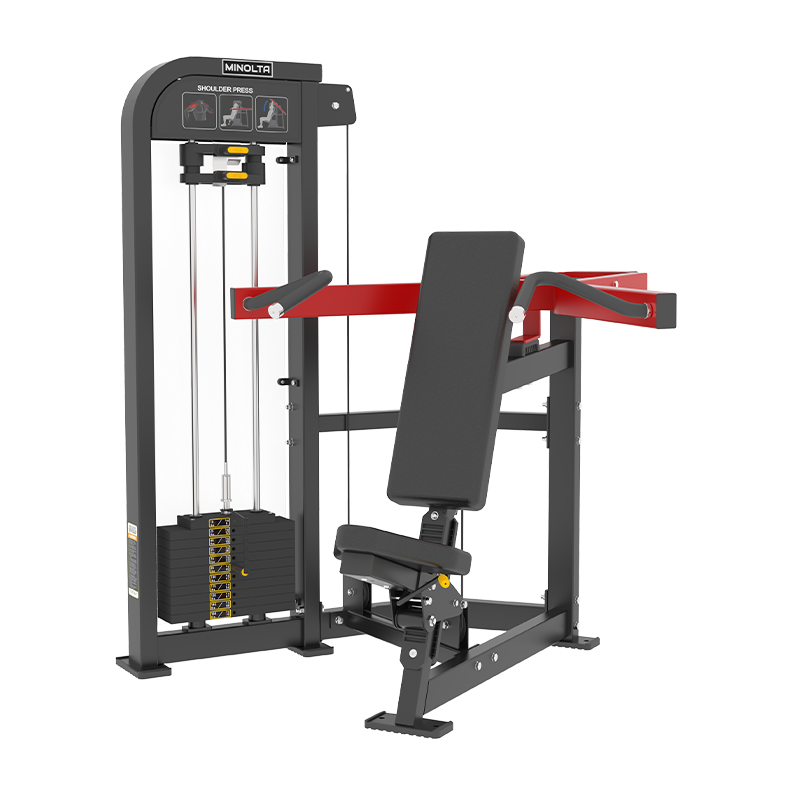
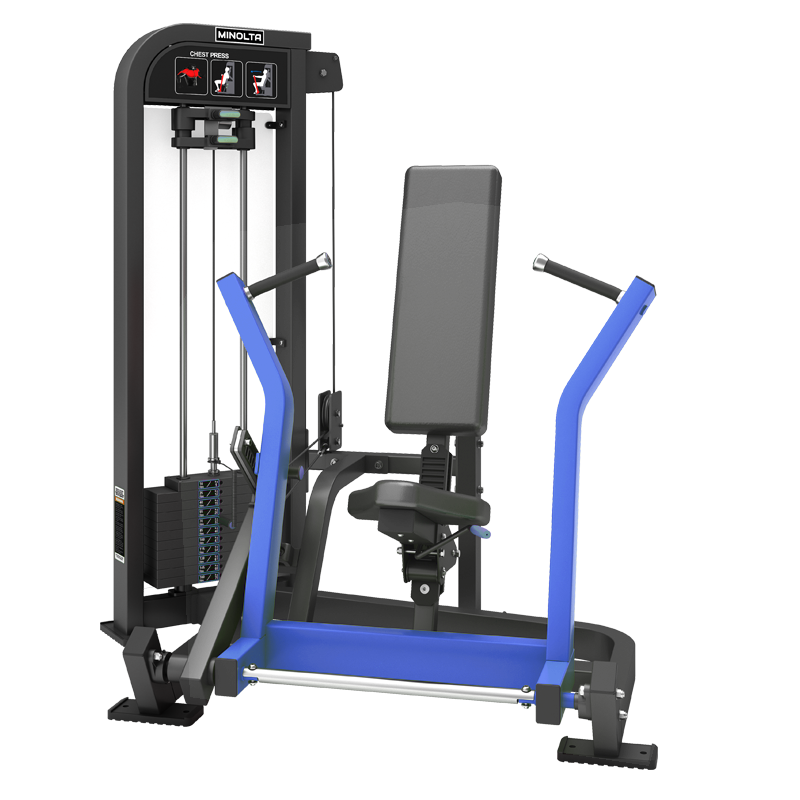
The product described here is a commercial strength-training machine labeled “SHOULDER PRESS.” Visually, it uses a steel tubular frame with a matte black finish, red moving arms, and a padded black seat and backrest. The visible weight stack, guide rods, and selector pin point to a selectorized resistance system rather than plate loading. The user changes resistance by moving the pin on the stack, which makes the machine fast to adjust between sessions.
The dual-arm movement is another useful detail. In many commercial environments, independent or semi-independent arm motion helps users establish a more natural pressing path than a fixed bar. That can be particularly helpful when shoulder mobility varies from user to user, which is common outside of dedicated strength clubs.
There is also a practical packaging advantage. Compared with a full free-weight press station, the footprint is compact. For facilities trying to fit more training value into a limited room, that is not a minor issue. Floor space is always more expensive than the brochure says it is.
Quick comparison: machine press vs. free-weight press
Seated dumbbell or barbell pressing
Free-weight pressing is valuable because it demands stabilization, coordination, and loading flexibility. It also requires user instruction, more attention to setup, and a greater tolerance for variation in technique. In a commercial environment, that variation is not always an asset.
Selectorized seated overhead press
A seated overhead press machine reduces setup time and makes load progression straightforward. The user sits, adjusts the seat, selects a resistance level, and begins. The movement pattern is more guided, which makes it easier to standardize across a broad user base. For facilities with mixed experience levels, that is often the stronger operational choice.
Where each format fits
If the target is athletic development with a heavy emphasis on stabilization, free weights still have a clear role. If the target is steady usage, easier supervision, and a lower barrier to entry, the machine often wins. The smartest facilities usually do not choose one and eliminate the other. They choose based on the training population, staffing level, and available floor area.
Why commercial buyers pay attention to the frame and motion system
For a shoulder press machine, the visible structure tells you more than decoration ever will. A welded steel frame, linkage system, guide rods, and upholstery are not just manufacturing details; they shape the machine’s long-term behavior. A stable frame helps the pressing path feel predictable. Good seat and back support help users maintain alignment. A smooth weight-stack mechanism reduces friction, which is important in a machine that may be cycled dozens or hundreds of times each day.
Shandong Minolta Fitness Equipment Co., Ltd. positions itself as a commercial equipment manufacturer with over a decade of experience, a 120,000-square-meter facility, and more than 300 types of equipment across strength and cardio categories. That background suggests an industrial production environment rather than a one-off fabrication shop. The company also notes export activity to more than 100 countries, which is relevant to buyers who need a supplier accustomed to commercial shipment, product variation, and multi-market demand.
That said, buyers should still verify the exact model details they care about. From the image and supplied information, we can identify the visible “MINOLTA” label and the general construction style. We cannot assume exact dimensions, steel gauge, load ratings, or certification status without documentation. In procurement, guessing is expensive.
Selection criteria that matter more than finish color
Many gym owners begin with visual appeal: black frame, red arms, neat upholstery, clean placard. Those things matter, but only after the fundamentals are right.
1. Entry and exit ease
The seated position should allow users to get in and out without awkward twisting. If the seat adjustment is too fussy or the start position feels cramped, usage drops. A good machine should invite repeat use, not require a small ritual every time.
2. Pressing path and shoulder comfort
Shoulder press equipment should support a natural overhead motion without forcing the elbows into a position that feels aggressive. Different users will interpret “comfortable” differently, especially across body sizes and shoulder histories, but a machine should not make obvious compromises here.
3. Resistance changes
Selectorized stacks are popular because they are fast. In a busy gym, speed matters. If users spend too long hunting for pins, plates, or adapters, the station becomes less attractive than the next machine on the floor.
4. Stability under repeated use
Commercial shoulder press equipment should feel planted, not lively. Frame stiffness, guide alignment, and linkage quality all influence that feeling. Even if the machine looks compact, it should not feel lightweight in operation.
5. Serviceability
Operators should ask how accessible the stack, cables or linkages, upholstery, and moving joints will be during maintenance. A machine that looks fine on day one but is difficult to service later becomes a hidden cost.
Common mistakes when specifying a shoulder press station
The first mistake is buying for novelty instead of use pattern. A machine can look premium and still be a poor fit if the user base is mixed, inexperienced, or highly space constrained. The second mistake is underestimating how often the station will be adjusted. If seat position and starting position are not intuitive, staff end up babysitting the equipment.
A third mistake is assuming any overhead shoulder press is interchangeable with a Seated Overhead Press designed for commercial use. The difference is not only the frame. It is the total system: pad geometry, handle placement, resistance feel, stack access, and the confidence users have when they sit down. In a real facility, confidence drives usage almost as much as biomechanics do.
Another quiet error is overlooking instruction. The placard on top is a small thing, but it helps. People who are new to strength training want fast orientation. Clear setup cues reduce misuse and help the machine earn its keep.
Practical buyer advice for sourcing teams
If you are sourcing a commercial shoulder press machine, ask for the information that affects installation and maintenance, not just the sales description. Confirm the exact model, dimensions, stack configuration, and service parts availability. If the seller provides drawings or spec sheets, compare them against your floor plan and door access before purchase. Shipping a large frame into a cramped facility is one of those problems that seems obvious only after the truck arrives.
For multi-site operators, it is also worth standardizing the training feel across locations. When users encounter similar seat logic, loading method, and press motion from one site to another, staff training becomes simpler. That is not glamorous, but it saves time.
And if the machine is being considered for rehab or lower-intensity environments, do not assume heavier commercial construction alone solves the issue. You still need appropriate movement feel and adjustability. Robust hardware is useful, but it is not a substitute for sensible ergonomics.
FAQ
Is a seated press machine better than dumbbells?
Not universally. Dumbbells offer more stabilization and freedom. A seated machine offers easier setup, more consistent loading, and better suitability for supervised or high-traffic environments.
Why choose a selectorized machine over plate loading?
Speed and simplicity. Selectorized systems are usually faster to adjust and easier for general users to understand. That makes them a strong fit for commercial facilities.
Does a seated overhead press take a lot of floor space?
It still needs proper clearance, but it is typically more compact than a full free-weight press station with benches, racks, and plate storage.
What should I verify before purchase?
Confirm dimensions, stack details, adjustability, service access, and documentation. Do not rely on visual inspection alone.
The decision worth making
If your goal is to deliver a reliable pressing station that serves a broad user base without constant supervision, a Seated Dumbbell Shoulder Press in machine form is a sensible buy. The commercial shoulder press machine described here combines the practical strengths buyers care about: a compact footprint, adjustable seating, enclosed weight-stack resistance, and a guided movement that is easier to manage than an open free-weight setup.
For sourcing managers, the key is to request the missing technical details before committing. For product teams, the value lies in choosing equipment that gets used correctly, not just equipment that looks strong on a showroom floor. If you are evaluating options for a gym floor, hotel fitness room, or rehab space, start with the press station that matches the actual user base, then validate the construction, serviceability, and footprint against your layout. That is the order that usually holds up after installation.