


Why a squat rack matters more than most buyers expect
A squat rack looks simple from a distance: two uprights, a bar catch, maybe a few storage pegs or pull-up options depending on the build. But anyone sourcing a squat rack for a gym, training studio, or serious home setup knows the real decision is not about shape. It is about load handling, space, safety, and how the frame behaves after months of daily use. That is where a lot of purchases go wrong.
For engineers and sourcing managers, the question is usually not “Do we need a rack?” It is “Which type of rack fits the training model, floor plan, and abuse level we actually have?” A home squat rack may be enough for a compact training room. A power rack may be the safer all-around choice when multiple users train unsupervised. A commercial squat rack, on the other hand, has to survive far more traffic, more rack-and-re-rack cycles, and more careless handling than the average garage gym unit. Those differences sound obvious, but they are often blurred in product listings.
Shandong Minolta Fitness Equipment Co., Ltd. sits on top of Ningjin’s hardware base and builds commercial gym equipment across strength and cardio categories. With over a decade in the fitness equipment sector, a 120,000-square-meter facility, and export experience in more than 100 countries, MND FITNESS is operating at the scale where these distinctions matter. That matters to buyers because a rack is not just a welded frame; it is a workflow decision.
Quick reference: which rack type fits which buyer?
If you are comparing rack formats, it helps to strip away the marketing language and look at use case first.
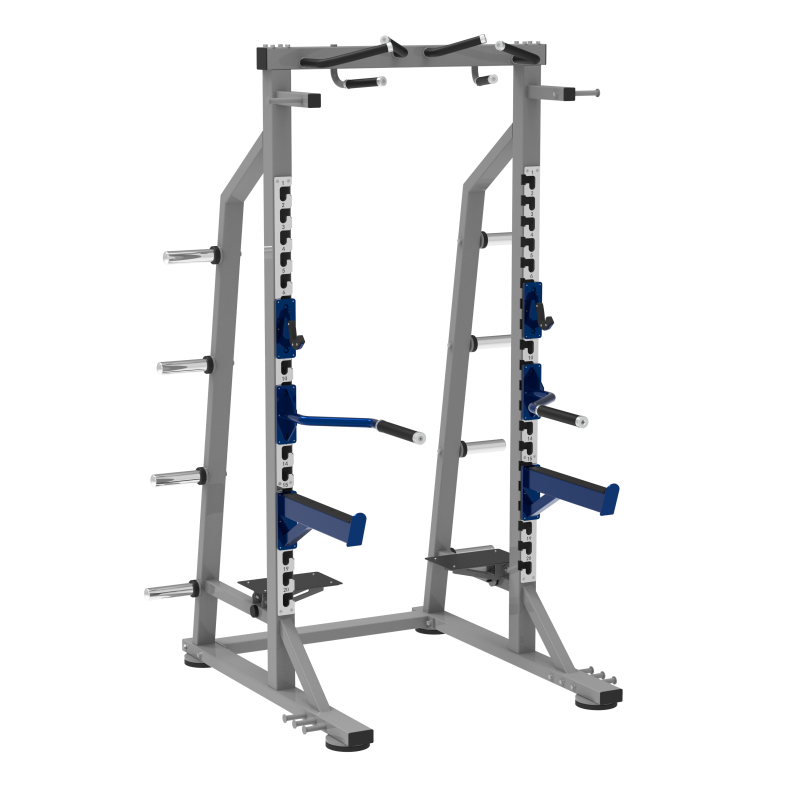
A home squat rack is typically the simplest option. It suits lower traffic, tighter spaces, and buyers who want a basic lifting station without enclosing the lifter. It is usually easier to place, easier to move, and less visually dominant in a room. The trade-off is obvious: less protection and less versatility.
A power rack adds more enclosure and more confidence under load. For many strength programs, it is the practical middle ground because it supports squats, bench work, pull-ups, and accessory movements. In a shared facility, that broader use case often justifies the larger footprint.
A commercial squat rack is built for repeated use and for the kind of wear that reveals weak welds, poor finish quality, or unstable base geometry. Buyers in commercial settings should care less about headline features and more about consistency across a batch.
An adjustable squat rack is worth a closer look when floor space is limited or when one station must serve multiple athlete heights, training styles, or room layouts. That flexibility can be useful, but adjustable systems also introduce more moving parts, and moving parts always deserve a harder inspection.
What buyers should evaluate before they choose
The first mistake is to start with features instead of the actual training environment. A rack that looks substantial in a catalog can still be wrong for a facility if the dimensions fight the room or the lift programming.
1. Footprint and training clearance
Measure the room honestly, including loading area, plate storage, walk paths, and the space needed for a spotter if that is part of the program. Many compact rooms can accept a squat rack but not a large power rack without creating traffic problems. That is a facility issue, not a fitness issue.
2. Stability and frame behavior
A rack should feel planted when the bar is racked aggressively or when a lifter steps in and out with uneven weight distribution. This is where base design, upright thickness, and overall fabrication quality show up. Buyers should be cautious of units that rely on appearance rather than real structural integrity.
3. Adjustability and user range
If your users vary widely in height, strength level, or training style, an adjustable squat rack can improve usability. But it should adjust in a controlled, repeatable way. Sloppy adjustment mechanisms create friction for staff and users alike. In a busy environment, “quick-adjust” only matters if it remains smooth after repeated use.
4. Compatibility with other exercises
Many buyers discover too late that a rack is being used for far more than squats. In practice, the station may also handle presses, pulls, deadlift setup, band work, or attachment-based accessories. That is why a power rack often earns its footprint. A simple squat station may be perfectly adequate, but only if the programming stays simple too.
Material, fabrication, and the details that usually decide longevity
For this product category, the visible differences are usually cosmetic. The more important questions concern welding quality, finish consistency, joint alignment, and how well the rack resists daily handling.
Minolta’s broader manufacturing base is relevant here because the company is not narrowly focused on one frame type. Its Strength Series includes multiple equipment families such as MND-AN, MND-FM, MND-FH, MND-FS, MND-FB, MND-E Crossfit, MND-F, MND-FF, MND-G, and MND-H. That breadth suggests a production environment familiar with both commercial and home-use strength equipment, which is useful when evaluating rack sourcing options.
Buyers should ask for the same practical evidence they would want from any industrial supplier: clear drawings, load assumptions, consistent hole spacing where relevant, and finish details that suit the training environment. For a high-traffic commercial squat rack, finish durability matters because chipped coating and exposed edges quickly become both a visual issue and a maintenance issue.
A cautious note: many specification sheets sound more impressive than they are. If a vendor cannot explain how a rack is intended to be used, or if the rack seems overloaded with features that do not fit the actual customer profile, that is usually a red flag.
Commercial gym versus home gym: the decision is not just price
The temptation is to treat the home gym market and the commercial market as points on one spectrum. In reality, they ask different questions.
A home squat rack usually needs to satisfy one or two users, limited sessions, and space constraints. It may be folded, wall-mounted, or relatively light in structure. Convenience matters more than batch consistency.
A commercial squat rack has to tolerate repeat use, poor bar placement, hurried unloading, and occasional misuse. In that world, a slightly heavier or less flashy rack can be the smarter purchase if it gives the operator fewer headaches over time.
What trips up buyers is assuming that an adjustable squat rack automatically solves every problem. It can be the right answer, but only if the adjustment system does not become the weakest point in the setup. In a home environment, that may be acceptable. In a facility, it may not be.
Common sourcing mistakes that show up later
One recurring mistake is underestimating the real loading pattern. A rack may be rated for a theoretical maximum, but the day-to-day abuse in a gym is a different story. Drops, re-racks, off-center loading, and hurried use reveal quality differences much faster than static numbers.
Another mistake is ignoring assembly and support. Buyers often focus on the rack itself and forget about installation time, hardware quality, and whether the supplier can provide straightforward documentation. A strong frame with awkward assembly can still become a weak buying decision.
A third mistake is buying for the current user base only. If the facility plans to add classes, open more training slots, or expand toward broader strength programming, the rack should not become obsolete the moment the business grows.
What to ask a manufacturer before placing an order
If you are sourcing a squat rack, the short list of questions is often more useful than a long checklist.
Ask what training environment the model is intended for. Ask whether the design is better suited to a power rack, a home squat rack, or a commercial squat rack application. Ask what accessories or expansion paths exist. Ask how the rack is packaged for export and whether the supplier can support consistent output across repeated orders.
For a company like MND FITNESS, with more than 300 types of exercise equipment and exports across Europe, Africa, the Middle East, South America, and Southeast Asia, the underlying value is not just product count. It is manufacturing repetition. Buyers in B2B channels should care about whether the supplier can keep dimensions, finish, and assembly experience stable from order to order.
Practical buyer advice before you sign off on the spec
Do not buy a rack because it looks heavy. Buy it because it fits the lifting pattern, the room, and the operator skill level. If the facility needs broad exercise coverage, a power rack may justify the extra footprint. If space is tight, a home squat rack or adjustable squat rack may be enough, but only if the use case is honest about that limitation.
For commercial procurement, consistency across units often matters more than any single feature. For home buyers, ease of placement and flexibility may matter more. It is easy to say all racks do the same job. They do not. They only look similar until users start putting real load on them.
FAQ: the questions buyers usually ask
Is a power rack always better than a squat rack?
Not always. A power rack is often more versatile and safer for unsupervised lifting, but it takes more room and may be unnecessary for simpler training needs.
When does a commercial squat rack make sense?
When the rack will be used often, by multiple users, or in a setting where durability and repeatability are more important than minimal footprint.
Is an adjustable squat rack worth it?
It can be, especially in space-constrained rooms or multi-user environments. Just be sure the adjustment mechanism is built for repeated use and not just for showroom convenience.
What should buyers look for first?
Start with room size, user profile, and training style. Then evaluate structure, adjustability, and finish quality.
Next step for sourcing teams
If you are evaluating a squat rack for a commercial project, a home-gym line, or a mixed-use training space, the smartest next step is to compare actual use cases rather than catalogs alone. A supplier with broad strength-equipment experience, such as Shandong Minolta Fitness Equipment Co., Ltd., may be able to support that process with a wider manufacturing context and more predictable production discipline.
The right rack is the one users barely think about after installation. That is usually a good sign. In fitness equipment, boring is often what quality looks like once the order is installed and the room gets busy.